
From a Few Big Clients to Many Small Ones
How an ad-creative agency spread its risk from a few big accounts to many SMEs by rebuilding its operating model to own outcomes, not just fulfil briefs.
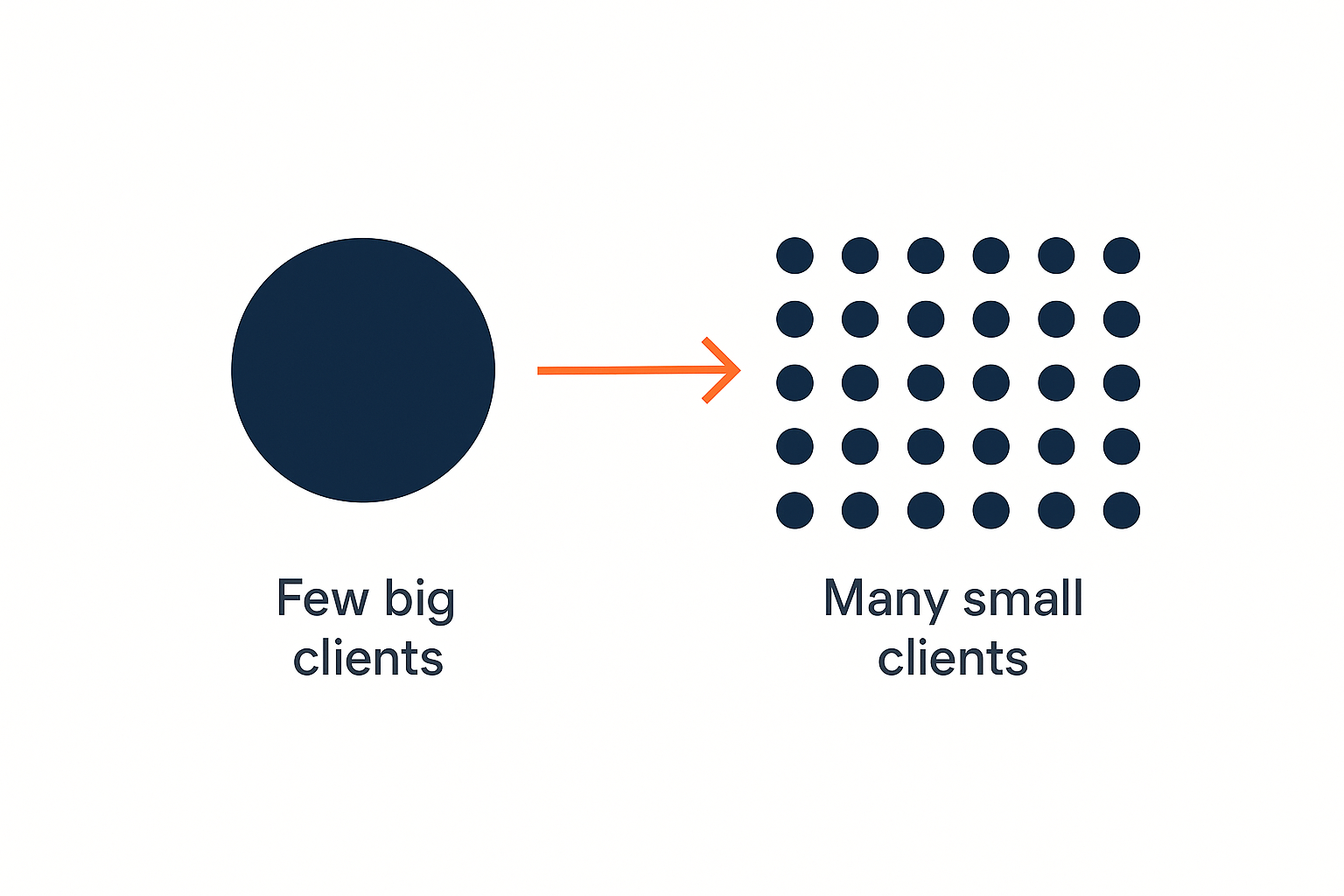
How an ad-creative agency stopped being a replaceable pair of hands and learned to own the whole outcome
Illustrative case study. Industry and situation are drawn from a real engagement; the firm name and identifying details are anonymised.
A founder-led advertising-creative agency producing video shoots and graphics — polished ad films, campaign visuals, social creative. The work was good, the team capable, and the revenue came from a small handful of large clients. That last fact was both the agency's comfort and its quiet danger. A few big accounts paid the bills, which felt like stability, but it meant that losing even one of them would tear a hole in the business overnight. The founder knew he needed to spread the risk across many smaller clients. What he hadn't yet seen was how completely that shift would change the kind of agency he had to become.
The comfortable trap of serving only big clients
Large clients are, in one sense, easy to serve. They arrive with a marketing team, an established process, and a brief already written. They have decided what they want; the agency's job is to execute it beautifully. There is real craft in that, and it is comfortable work — someone else has thought it through, and the agency fulfils the request.
But that comfort hides a structural weakness. An agency that only fulfils briefs is, by definition, a pair of hands, and pairs of hands are replaceable. When you execute someone else's strategy, the client can swap you for the next capable studio without losing anything that belongs to them, because the thinking — the part that's hard to replace — never lived with you in the first place. So the agency was carrying the worst of both worlds: a dangerous concentration of revenue in a few accounts, and a position within those accounts that made it easy to drop. The thing that felt like stability was actually fragility, wearing a comfortable coat.
Why "just get more SMEs" was harder than it looked
The obvious answer was to win many small and mid-sized businesses, so that no single client could sink the firm. But the founder's first attempts produced friction at every turn, and the reason was instructive. An SME does not buy what a large client buys. A large company buys a part of the process — the creative execution — because it already owns the rest. An SME owns none of it. It has no marketing team, no one to write a brief, no campaign strategy, and often no clear idea of what good even looks like. When an SME hires an ad agency, it is not buying ad films. It is buying the entire process — the thinking, the strategy, the creative, the running of the campaign, and ultimately the customers at the end of it.
The agency was not built for that. Its internal processes had been shaped around fulfilling clean briefs from clients who knew what they wanted—faced with a small business that needed to be guided through every step—and who had limited money to spend and little patience for a long, expensive process—those same processes generated friction rather than results. The agency was being asked to manage an end-to-end advertising and lead-generation engine, something it had never had to do, for clients whose budgets left no room for inefficiency. The mismatch was not a marketing problem or a sales problem. It was an operating model problem.
Becoming the firm that owns the result, not the brief
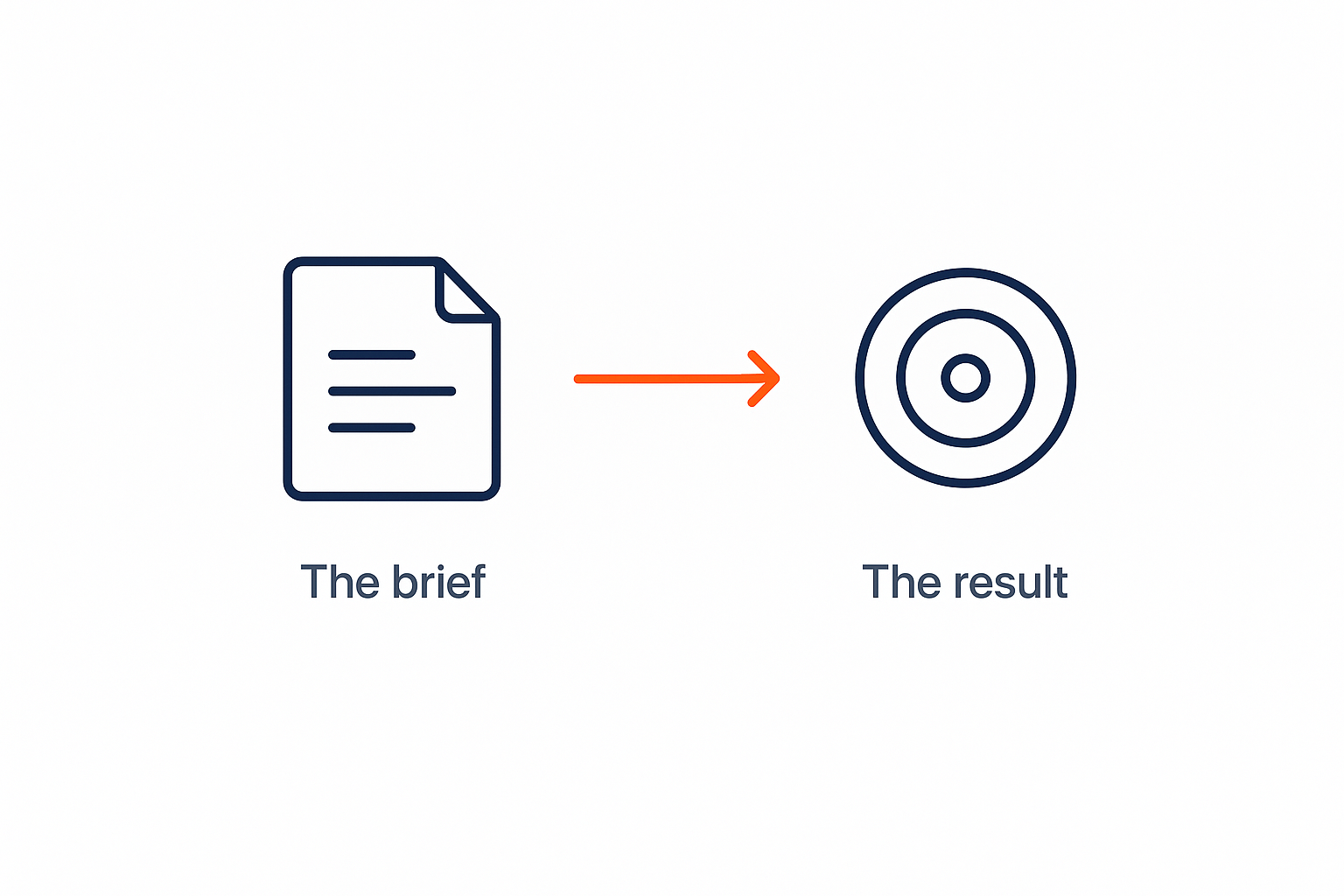
The repositioning started by accepting what an SME actually wants, and building the agency around it. The promise had to move from "we produce your ad creatives" to "we bring you customers" — from delivering outputs to owning an outcome. That is a far harder thing to sell and to deliver. Still, it is also the only version of the agency that an SME has any reason to pay for, and, not coincidentally, the version that is almost impossible to replace. Once you own a client's entire path from idea to lead, you are no longer a swappable studio; you are the engine their growth runs on.
Making that real meant rebuilding the internal process rather than tweaking the pitch. The agency had to add the parts it had always let big clients handle — the strategy, the campaign planning, the lead-generation mechanics — and stitch them into a single, repeatable system it could run end-to-end. This was the genuine work of the engagement: turning a brief-fulfilment shop into an outcome-owning one, with a defined process that didn't depend on the client arriving with the answers.
Designing for small budgets instead of fighting them
The other half of the friction was money. SMEs cannot absorb a sprawling, bespoke, open-ended process, and trying to serve them with one designed for large accounts has made every early engagement painful. So the offer was productised deliberately for the SME reality: a defined, fixed-scope package with clear boundaries and a predictable price a small business could actually commit to, structured so the agency could deliver it efficiently and repeatably across many clients rather than reinventing it each time. Boundaries did the work that custom scoping could never — they protected the agency's finances on thin budgets and gave the SME the certainty it needed to say yes. Standardising the process was not a compromise on quality; it was the only way to serve many small clients profitably without the friction that had been quietly draining both sides.
The result
The agency moved from a precarious handful of large accounts to a broader, steadier base of smaller ones — and, in doing so, changed what kind of firm it was. By choosing to own the whole process for SMEs rather than fulfil a slice of it for big clients, it traded a comfortable but replaceable position for a harder but far stickier one. The internal redesign that the SME market forced on it — real strategy, end-to-end campaign ownership, a productised and affordable shape — was precisely what made the agency indispensable to the clients it now served, and what spread its risk across many relationships instead of betting the business on a few.
The deeper lesson runs against the instinct of most agency founders. Serving a few big clients feels safe, but it isn't; the work is replaceable, and the revenue is concentrated. Serving many small ones feels chaotic and is the more durable position — but only if the agency is willing to stop being a pair of hands and become the owner of the outcome, with an operating model and a price built for that job rather than inherited from the old one.
About the Author
Anoop Kurup
Sales-systems consultant for founder-led services businesses. Based in Bangalore.
More about meStill depending on referrals?
Find out how predictable your pipeline really is. Ten questions, three minutes, an honest score and the one thing to fix first.
Take the Sales Scorecard