
From AIDA to AI: Your Old Frameworks Are the Brief
AIDA and PAS are not dated theory. They are the structure an AI needs to stop producing mush. A framework is a brief; without one, a model writes about nothing.
Ask a model to write a sales email for your consulting firm and you will get a sales email. Greeting, three tidy paragraphs, a line about understanding the challenges businesses face, and a close that invites the reader to hop on a quick call. It arrives in four seconds. It is grammatical. It is about nothing.
The usual conclusion is that AI can't write. That isn't it. The model wrote exactly what it was asked for, which was an email, not an email to a particular person about a particular problem they actually have. It filled the gap you left with the average of everything it has ever read. The average of everything is mush. It was always going to be mush.
Which brings me to the strange thing about this moment. The most useful asset most marketers have for working with AI is the one they assumed was obsolete: the old messaging frameworks. AIDA. PAS. Before/After/Bridge. The structures you learned early, used for a while, and quietly filed under "theory I already know". They are not theory. They are briefs. And a brief is the one thing a model cannot generate for itself.
A very fast writer with no brief
If you have ever briefed a freelancer badly, you already know what a model without a framework produces. You send a one-liner: "we need a page for the new service, make it sound premium". A week later something arrives that is competent, plausible, and useless. The writer wasn't bad. You gave them nothing to write about, so they wrote about the category. Every sentence is defensible and no sentence is yours.
An AI is that writer, except it returns the draft in four seconds and never asks a clarifying question. Speed makes the problem worse, not better. A slow freelancer at least gives you a week in which to realise you didn't think it through. The model just hands you the mush and waits, cheerfully, for the next request.
So the interesting question was never "which tool writes best". It's "what does a writer need from me before they can write anything worth reading". Marketers answered that question decades ago and wrote the answer down. We just filed it in the wrong drawer.
Computers are dumb. Models are polite.
I have been automating my own work since 2006, mostly out of laziness, which I consider a respectable engineering motivation. My first proper desk job was in a research lab: patents, literature, competitive strategy. It felt like being chained to a laptop that did nothing by itself. So I repurposed the Caps Lock key, which nobody uses, into a floating search bar that could open files and run scripts. Then Excel macros. Then Python. Then a long tail of adventures I won't inflict on you here.
Twenty years of that teaches you one thing above all: a computer does precisely what you specify and precisely nothing you left out. That is a feature. When my macro hit a case I hadn't thought about, it stopped and threw an error in my face, and the error told me which part of my thinking was missing. The machine was dumb, and its dumbness was honest.
Language models broke that arrangement. They don't stop at the gap in your thinking. They fill it, smoothly, in complete sentences, with something that reads like it might be right. A macro fails loudly. A model fails politely. That politeness is the entire problem, because the output looks finished, so you never go back and find the part you didn't think through.
Which is why a framework matters more now than it did when we were writing everything by hand. When you write the email yourself, the framework is a memory aid; you carry the context in your head whether or not you name it. When a model writes it, whatever you didn't name doesn't exist. The framework stops being a reminder and becomes the specification.
Why the old frameworks survived
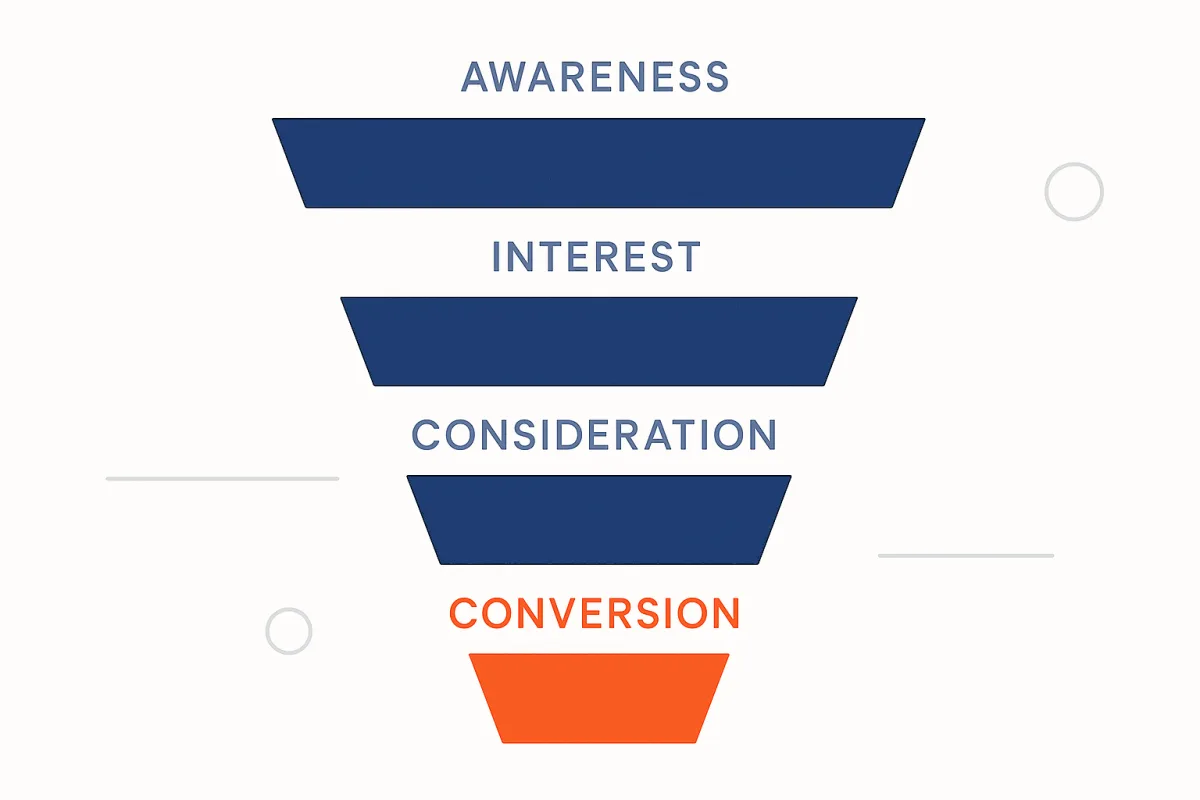
AIDA is roughly a hundred and twenty years old and it has outlived every channel it was written for. That is not an accident of tradition. It survived because it isn't a template; it's a decision sequence. It says: before anything else happens, you must earn a moment of attention with something true and specific. Then you must name a problem the reader recognises well enough to keep reading. Then you must connect what you sell to the outcome they actually want. Then you must ask, plainly, for one thing.
Read that as instructions to a writer and it's obvious what it is. It's a brief. Four slots, in a fixed order, each one demanding a different piece of judgement from you. PAS is a shorter brief with a sharper edge. Before/After/Bridge is the same brief written for people who think in states rather than emotions. StoryBrand is a longer one with more slots. They differ in shape and they agree entirely on the principle: a persuasive message has parts, the parts have an order, and each part answers a question about the reader.
None of that changed when AI arrived. What changed is who fills in the slots and how fast. The framework used to be the thing you internalised and applied by hand. Now it's the thing you hand over: the structure the model works inside, so that its speed produces something shaped instead of something average.
The slots are the work
Here is the part that gets skipped. A framework tells you there are four slots. It cannot tell you what goes in them. That is your judgement, and it is the only scarce thing in this entire arrangement.
Which is why a prompt full of square brackets is worth almost nothing. Half the "AI prompt libraries" going around are AIDA with [TARGET AUDIENCE] and [PAIN POINT] left as blanks, as though the blanks were the easy part. The blanks are the whole job. Fill them with something real and the model produces something real. Fill them with "B2B decision makers" and "struggling with growth" and you get mush again, now with a professional structure holding it up.
The difference looks like this:
Write the opening of a sales email using AIDA.

Attention: their biggest client just told them procurement is
  now involved in renewals.
Interest: last year two accounts went the same way and they
  only found out at the renewal call itself.
Desire: a quarterly account review that surfaces the risk in
  month one, not month eleven.
Action: reply with a date for a 30-minute review.

Reader: MD of a 40-person IT services firm, sells entirely on
relationships, has never had a formal renewal process.
Tone: plain, no adjectives, under 150 words.
Every line that makes that prompt work is a line I had to know. AIDA supplied the four labels and the order. It could not supply the procurement detail, the two lost accounts, or the fact that this particular MD has never run a renewal process and is slightly embarrassed about it. That came from having sat in the room. The framework organised my knowledge; it did not manufacture it.
Notice also what the model is now free to do: choose the words. That's a real division of labour, and it's the right one. Sentence construction is a task. Knowing what your buyer is quietly worried about is not a task; it's the business.
Where the time actually goes back
Once you see frameworks as briefs, the useful practice follows on its own, and it's smaller than the "AI workflow" industry would like you to believe.
Take the one framework you already reach for by instinct. Write it out once, properly, as a brief. The slots, the order, and the standing context that never changes: who you sell to, how they talk, what you sell, what you refuse to claim, what your writing sounds like when it's yours. That last part matters more than people expect. A model has no house style, so it borrows one, and the one it borrows is LinkedIn's. If you don't tell it what you sound like, you will sound like everyone.
Then use it. The per-message work drops to what it always should have been: filling four slots with things you know about one reader. That takes minutes and it is thinking, not typing. Everything downstream is the part you were never precious about anyway: drafting, tightening, three variants of the closing line.
Then keep the brief. Not in a chat window that you lose on Tuesday; in a file, where you can improve it. This is the bit almost nobody does, and it's where the compounding lives. Each time a draft comes back wrong, you have learned something specific about what your brief failed to say. Add it. Over a few months the brief stops being a framework you borrowed and becomes a written record of how you think about your market. That artefact is worth considerably more than any individual email it produces, and it's the only version of this that a colleague can pick up and use without being you.
What this doesn't fix
It doesn't fix not knowing your buyer. If you cannot name, in one sentence, the thing your prospect is actually worried about at the moment they read your email, no framework and no model will find it for you. You will get faster mush, spelled correctly, delivered on schedule. Speed applied to an empty brief just gets you to the wrong place sooner.
That is the honest limit, and it's worth naming, because "AI for marketing" is usually sold as a substitute for the thinking rather than an amplifier of it. It's an amplifier. Amplifiers are indifferent to what you feed them.
So the sequence runs the other way round from how it's usually taught. Not: learn the tool, then find things to write. Rather: know your buyer, write the brief, and let the tool do the typing. The frameworks you already know are the format that brief comes in. They were always briefs. We just didn't have anyone fast enough to hand them to.
If your messaging keeps coming out generic, the framework is rarely the problem. The missing brief usually is, and behind it, a fuzzy picture of who you're actually selling to. If you want a second pair of eyes on yours, get in touch and tell me what you're seeing.

About the Author
Anoop Kurup
I'm a marketing consultant for B2B service firms in India. I fix the positioning, visibility, and lead generation behind weak sales. Before this: a research lab at GE, then patents and competitive strategy, then an intellectual-property firm I built and exited. I work with founders one engagement at a time from Bangalore.
More about meRelated reading
Getting clients beyond referrals
How Experts Should Pitch at Networking Events: Lead With the Problem, Not the Service
At a networking event, nobody buys a service they've just heard of. Lead with the problem instead. Here's what to say when someone asks what you do.
Getting clients beyond referrals
A LinkedIn Content Rhythm That Doesn't Burn You Out
Most founders quit LinkedIn by week three because nothing comes of the posts. What content can and cannot do, and the weekly routine that keeps it cheap.
Getting clients beyond referrals
Interest Is Not Intent: The Handshake Happens Inside Your Head
For a founder-led firm, the gap between interest and intent is not a handover between teams. It is a judgement you make alone, and usually badly.
Still depending on referrals?
Tell me what's going on with your sales. I'll tell you honestly if I can help.
Get in touch