
Positioning Is a Problem, Not a Profile
Positioning by industry, client size or service list describes you, not the client. The position that gets you called by name is a specific, painful problem.

Imagine walking into a doctor's clinic and, when she asks what's wrong, you say: "I'm forty-two. I run a mid-sized business. I'm based in Pune."
All true. None of it useful. She cannot do anything with a profile. She needs a symptom: where it hurts, how badly, since when. Only then does she know whether you need rest, a physiotherapist, or a cardiologist this afternoon.
Now read your own positioning line back to yourself. Most of them sound exactly like that patient.
"We're a boutique consulting firm working with mid-market manufacturers across South India, offering strategy, process improvement and digital transformation."
Every word of that is true, and not one word of it says where it hurts.
A profile is not a position
There are three ways service firms usually describe themselves, and all three have the same flaw.
By industry. "We serve manufacturing companies." This names a room, not a reason. There are a dozen other firms standing in that same room, saying the same sentence to the same people. Choosing a vertical narrows your list of prospects without giving any one of them a reason to choose you over the firm next door with an identical line.
By client size. "We work with mid-market businesses." This describes who you are willing to accept money from. It is an internal filter that has escaped onto the website. The client reads it and learns nothing except that they qualify, which tells them you are available, not that you are the right call.
By service list. "Strategy, process improvement, digital transformation." A list is a menu, and a menu gets shopped. The moment you lead with deliverables, you have invited a comparison of deliverables, and the only line on that comparison the buyer can actually read is the price.
The common thread: all three describe your firm. None of them describe the client's situation on the morning they decide something has to be done. That gap is the whole problem. Buying is triggered by a situation, not by a supplier's self-description, and if your positioning contains no situation, it cannot be the thing that triggers a call.
The specialist is not a better doctor
The general physician and the cardiac surgeon are not separated by skill. Both trained for years, both are excellent at what they do, and one of them is paid many times more per hour than the other. The difference is not talent. It is the point at which each of them gets called, and how the problem is named when the phone rings.
You go to a general physician when you feel unwell. Vague, many possible causes, mild-to-moderate discomfort. You do not think hard about which clinic. You go to the nearer one, or the cheaper one, or the one your neighbour mentioned. The physician is interchangeable, not because she is replaceable as a professional, but because the problem you brought her was not specific enough to require anyone in particular.
The surgeon is called when the problem has a name and the name is frightening. Nobody price-shops a cardiac surgeon on the way to theatre. Nobody asks for three competitive quotes. The naming of the problem is what removes the comparison.
This is the reframe I want you to hold on to: your positioning is not a description of your firm. It is a description of the moment someone picks up the phone.
Two things decide whether that phone rings
Only two things about the problem you attach yourself to actually matter, and it helps to hold them separately.
The first is how specifically the problem is named. Not how specific your service is, but how specific the problem is, in the client's own language, before you arrive.
The second is how much it hurts. Whether this is an irritation someone raises in a quarterly review, or the thing that is currently keeping a director awake.
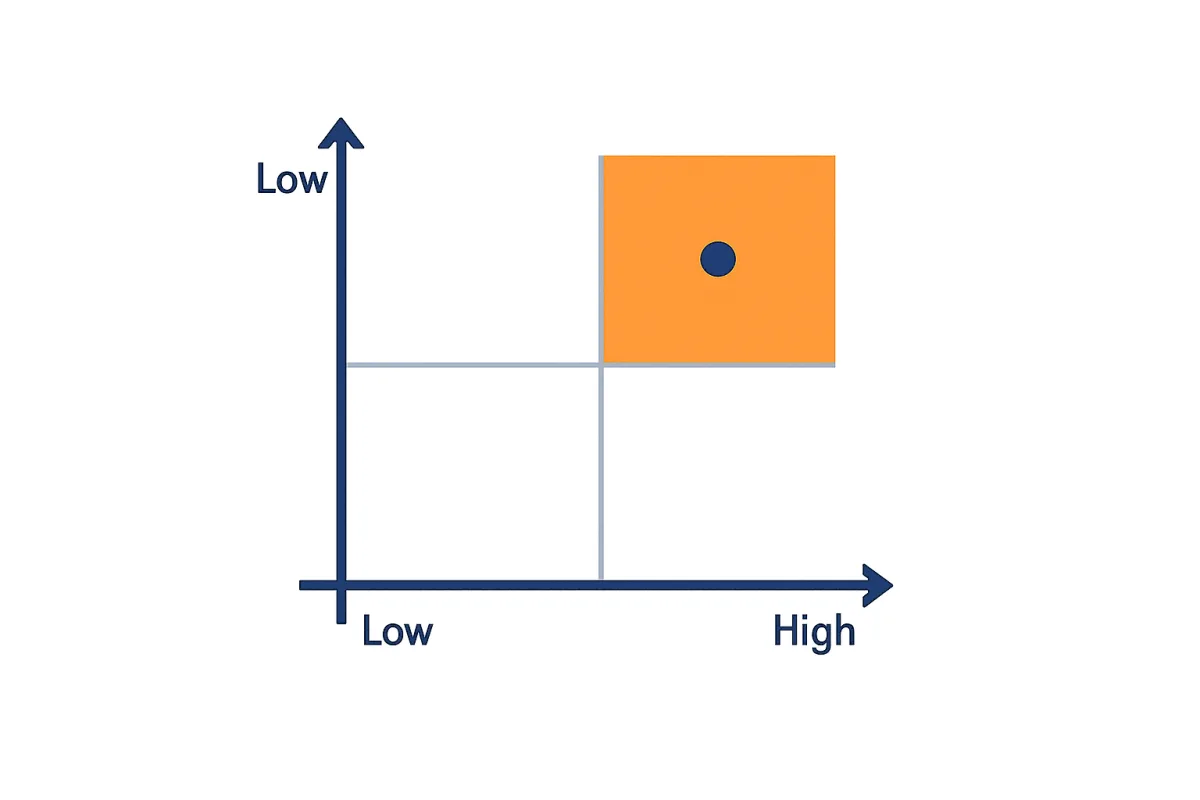
Put those two together and four situations fall out.
Vague and mild is invisible. "We help businesses run better." Nobody has ever woken up with this problem. There is no moment; there is no call.
Specific and mild gets bought as a task. Monthly reports, site maintenance, a defined bit of production work. The problem is clearly named, which is good, but it does not hurt enough to matter, so it is bought on price and dropped without a conversation. Precision without pain just makes you easy to compare.
Vague and intense is the crowded, expensive-looking trap, and it is where most struggling service firms actually sit. "We grow revenue." "We drive transformation." The pain here is completely real: there is budget behind it, and the buyer genuinely wants it solved. But because the problem has no name, the buyer cannot tell you apart from the agency, the trainer, the CRM vendor, the freelancer and their cousin who runs ads. Everyone claims the same outcome. So the buyer does the only rational thing available: lines up five proposals and reads the one variable that differs. Price. You did not lose on merit. You lost because nothing in the situation forced a specific choice.
Specific and intense is where you get called by name. "The founder is the only person who can close a deal, and he is now the reason nothing scales." That is a named problem that hurts. The person carrying it does not want a category of help. They want the one who fixes that.
Here is the part most people get backwards. When a firm realises it is being treated as a commodity, the instinct is to push harder on intensity: bigger claims, bolder outcomes, more transformation. That is the wrong direction, because intensity is not yours to set. The client's problem hurts exactly as much as it hurts; no adjective you add changes that. Specificity is the axis you actually control. It is a choice about which problem you claim and how plainly you name it, and it is available to you this week, at no cost, without a single new capability.
Why founders resist naming one problem
The resistance is almost never about whether the argument is right. It is about the arithmetic, which feels wrong at first.
Naming one problem looks like shrinking the market. If I say I fix this one thing, I have just disqualified everybody who has a different thing. Surely fewer prospects means less revenue.
But you are not choosing between a big market and a small one. You are choosing between being a possibility for many and the obvious answer for a few. A vague position does not actually give you access to that larger market; it gives you access to the shortlist, in an unwinnable comparison, at a price set by whoever is most desperate that month. A specific position reduces how many people call you and raises the share of those who buy, close quickly, and never open the conversation with "what would this cost, roughly?"
It also helps to be clear about what positioning is and isn't. Naming a specific problem does not mean refusing other work. Your existing clients will still ask you for adjacent things, and you should still do them. Positioning is what you lead with: the thing you are found for and remembered for. It is the front door, not the boundary wall.
The second resistance is quieter and more honest: it feels like a demotion. Going from "strategy consultant" to "the person you call when the founder is the bottleneck" sounds smaller. It sounds like you have given something up. What you have given up is the pleasant vagueness that let you feel senior in every room while being essential in none.
Where to find yours

You do not find this in a brainstorming session. A whiteboard will only give you back your own language, which is the language that put you in the vague row to begin with. You find it by looking backwards at work you have already done, and asking four questions about it.
Which engagements arrived with a deadline attached? A date is the cheapest proxy for intensity there is. Where a client named a date, the pain was real.
Which ones did the client arrive already knowing they had the problem? If you had to spend the first three calls convincing them the problem existed, that problem is not the one to position against; you were doing unpaid education, not selling. The problems worth owning are the ones the client walked in already carrying.
Which ones closed quickly, and more importantly, what words did the client use in the very first conversation? Their words, not yours. Write them down verbatim. The problem you can position against is the one clients already have language for, and their language is almost always plainer and more specific than the language on your website.
And which ones had somebody's job attached to them? Not the company's fortunes in the abstract, but an actual person whose standing depended on this being fixed. That is where intensity lives.
Then apply one test. Could the client have written your positioning line themselves, before they met you? If the answer is no, it is your language, not theirs, and it will not do the work of getting you called.
What actually changes
The change does not show up as a bigger market. It shows up in the shape of the conversations.
Your inbound gets smaller and different. Fewer enquiries, but they open differently: people arrive describing a situation rather than requesting a quote, because the situation is what brought them.
The conversation stops being about scope and starts being about timing. "How much does it cost" gets replaced by "how soon can you start", which is a completely different negotiation and one you are far better placed to win.
And the comparison changes. You stop being one of six firms that all promise growth, and start being the one somebody was told to call. That is not a pricing achievement. It is a naming achievement.
Your positioning isn't a description of your firm. It's the sentence a client says to a colleague on the day they decide something has to be done. If that sentence is "we should probably get some strategy help", you will be one of six, and price will decide it. If it's "call the one who fixes that", you'll be one.
If you're not sure whether your prospects can name the problem you solve, or whether you're stuck in the vague-and-intense crowd competing on price, get in touch and tell me what you're seeing. I'll tell you where your pipeline is leaking and what to fix first.

About the Author
Anoop Kurup
I'm a marketing consultant for B2B service firms in India. I fix the positioning, visibility, and lead generation behind weak sales. Before this: a research lab at GE, then patents and competitive strategy, then an intellectual-property firm I built and exited. I work with founders one engagement at a time from Bangalore.
More about meRelated reading
Positioning and pricing
Positioning for Consulting Firms
Most consulting firms describe themselves the same way. Here is how to choose a position your market actually cares about, and own it.
Positioning and pricing
A B2B Messaging Framework That Sells Services
A messaging framework for B2B services firms: what to say, in what order, so prospects understand what you do and why it is worth paying for.
Positioning and pricing
How to Differentiate a B2B Services Firm
When prospects cannot tell you apart, they choose on price. Here is how a B2B services firm builds real differentiation, beyond claiming quality.
Still depending on referrals?
Tell me what's going on with your sales. I'll tell you honestly if I can help.
Get in touch