
Why B2B Service Businesses Struggle With AI Adoption: It's a Business Model Problem
Most B2B service founders aren't resisting AI; they're protecting a system that's worked for years. Here's what actually needs to change.
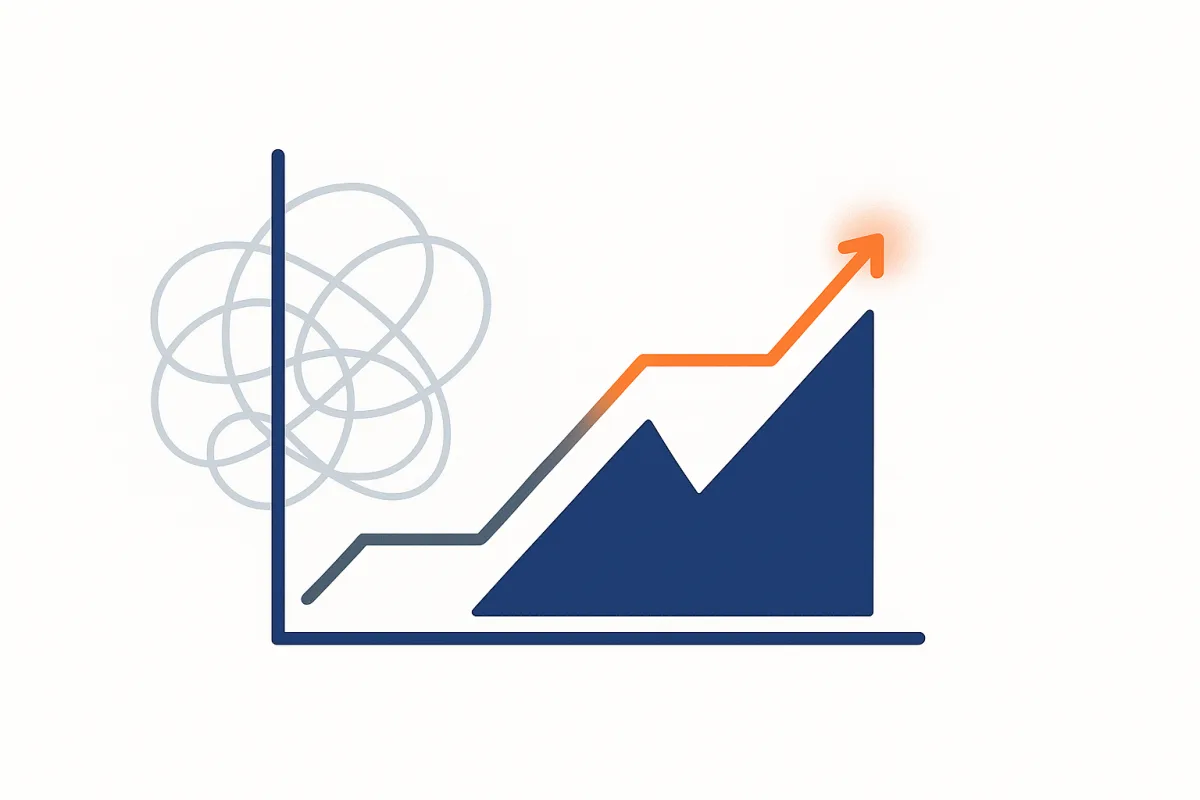
The typical advice for AI adoption in service businesses runs something like this: start with one process, find a tool that fits, build from there. It's practical advice. And for most B2B service founders, it produces the same result: a few useful experiments at the edges of the business, followed by a slow drift back to how things were.
This isn't because founders are resistant to change. In most cases, they're curious, engaged, and genuinely interested in what AI could do for their business. The problem is structural. Real AI adoption doesn't require better tools or more willingness. It requires a different business model. And most advice about AI for service businesses never gets to that.
This article is an attempt to get there.
Why Effort-Driven Businesses and AI Don't Naturally Fit
For most expert-founders, the business was built on a specific model: effort-driven delivery. The founder, or their team, is the primary input. Revenue is tied to time, responsiveness, and personal expertise. Clients pay for access to the founder's knowledge and judgement, and for the confidence that comes with having the go-to person on their side.
This model is remarkably effective. It generates referrals, builds reputation, and produces real revenue without requiring a marketing machine or a structured sales process. Many B2B service businesses reach real scale on this model alone.
But it creates a specific kind of constraint when AI enters the picture. If work becomes faster and more systemised, the relationship between time and value breaks down. A deliverable that used to take 8 hours now takes 90 minutes. Does that mean the price drops? Does it mean the founder can serve more clients? Does it change what the client is actually paying for?
These questions don't have obvious answers. And rather than working through them, most founders avoid them by staying at a level of AI use that doesn't force the issue.
The Illusion of Adoption
What "staying at the edges" looks like in practice: attending AI workshops, experimenting with ChatGPT for drafting emails, using a transcription tool for client calls. Useful. Genuinely time-saving. But not fundamentally changing how the business creates or delivers value.
This is what distinguishes surface-level AI adoption from deep integration. Surface-level adoption treats AI as a collection of shortcuts: ways to do existing tasks faster. Deep integration treats AI as infrastructure: the means to redesign how services are packaged and delivered.
Most B2B service founders are doing the first. The second is what actually changes the business.
The gap between them isn't knowledge or willingness. It's that the second requires something the first doesn't: stepping back from day-to-day delivery long enough to redesign the model. For founders who are the bottleneck in their own business, which is most of them, that time never arrives.
The Business Model Shift AI Actually Requires
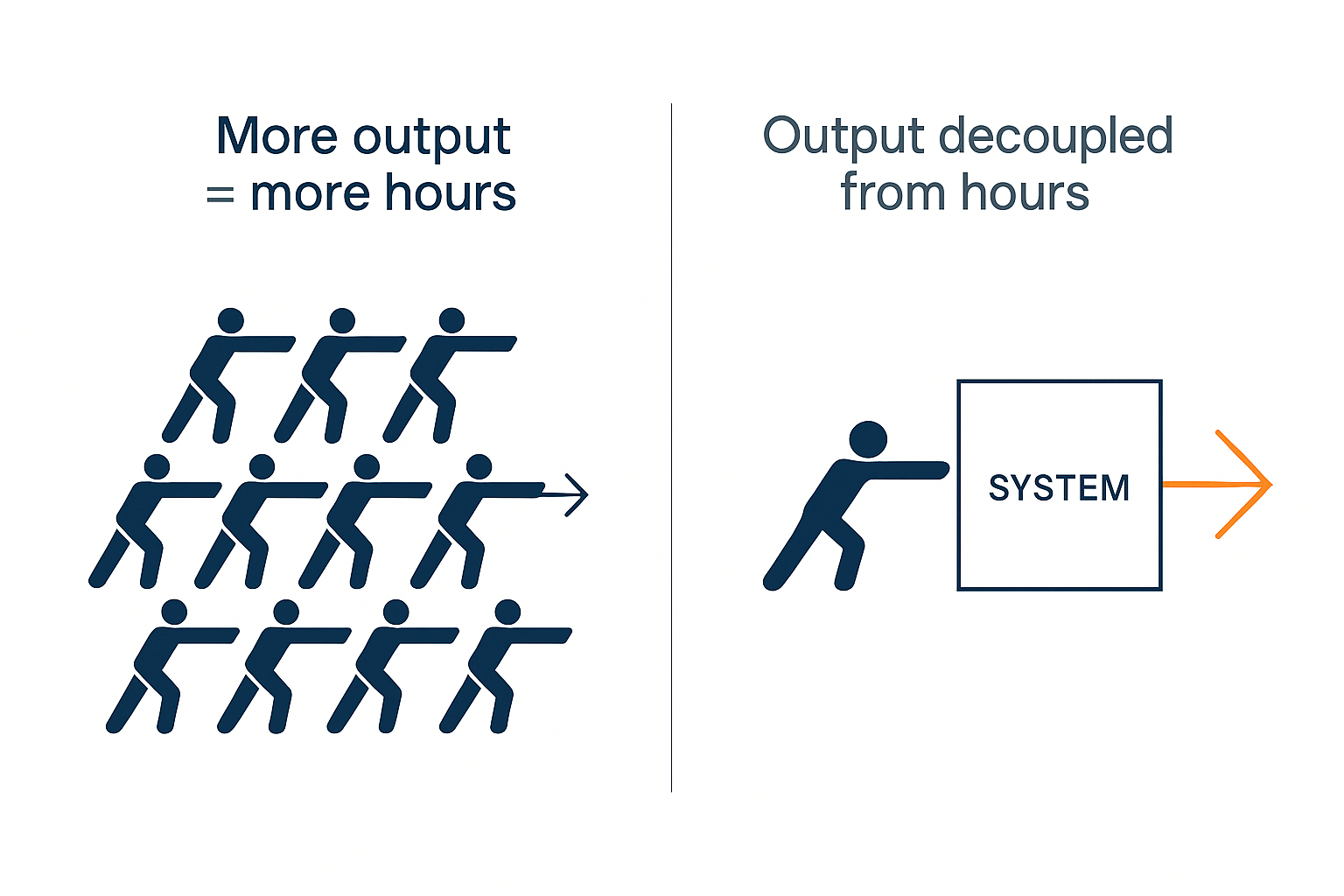
Here's the reframe worth sitting with: AI adoption for service businesses is not primarily a tool problem. It's a business model problem.
Deep adoption requires moving from effort-driven delivery to system-driven outcomes. In an effort-driven model, the founder's time and presence is the primary value driver. In a system-driven model, the founder's expertise is encoded into processes, frameworks, and automated workflows, and the founder's role shifts from doing to designing and overseeing.
That shift is significant. For founders whose identity is tied to being the expert problem-solver, the one clients call when things get complicated, this is not a comfortable transition. It asks them to rethink what they're selling, what their role is, and what the business looks like without them at the centre of every delivery.
None of that can happen while the founder is in firefighting mode. The redesign requires space. Most founders don't have that space because their business model keeps them fully occupied.
What Actually Needs to Happen First
The founders who make substantive progress with AI adoption share a common starting point. Before choosing tools, they answer a prior question: what would this business look like if my expertise ran through a system rather than through me personally?
This question reframes the adoption challenge entirely. Instead of asking "which AI tools should I use?", it asks "what is the system my AI tools should power?" The answer shapes everything: how services are packaged, how delivery is structured, how client relationships are managed at scale.
Once that question is answered, AI adoption becomes much more directed. The tools aren't solutions looking for problems; they're components of a system that already has a clear purpose.
For a consulting firm, this might look like moving from bespoke engagements to a structured diagnostic and implementation model, with AI handling research, synthesis, first-draft documents, and follow-up sequences. For a CA firm, it might mean moving from reactive compliance work to a systemised client communication and advisory model.
The specifics vary. The principle is the same: the model change precedes the tool selection.
The Question Worth Asking
Maybe your AI experiments have been genuinely useful: you've saved time, automated a few tasks, reduced some friction. If nothing has fundamentally changed about how your business creates and delivers value, that's a signal.
It doesn't mean you've failed at AI adoption. It means you may have adopted AI into an unchanged model. The tools are doing their job. The model is still the constraint.
The work worth doing is the prior work: rethinking how your expertise reaches clients, how your services are packaged, and how your business would function if your personal time were no longer the bottleneck.
AI is the engine for that business. But first, the business has to be built.
If your business still runs through you personally, that's the real constraint, on AI adoption and on growth. If you want an honest read on where your sales depend on you, get in touch and tell me what you're seeing.

About the Author
Anoop Kurup
I'm a marketing consultant for B2B service firms in India. I fix the positioning, visibility, and lead generation behind weak sales. Before this: a research lab at GE, then patents and competitive strategy, then an intellectual-property firm I built and exited. I work with founders one engagement at a time from Bangalore.
More about meRelated reading
AI and marketing systems
AI for Client Acquisition: What Actually Works
AI will not replace your judgement, but it will remove the grunt work from getting clients. Where AI genuinely helps a B2B services firm, and where it quietly ruins trust.
Positioning and pricing
Positioning for Consulting Firms
Most consulting firms describe themselves the same way. Here is how to choose a position your market actually cares about, and own it.
Scaling beyond the founder
How to Scale a Consulting Business Beyond You
Growth stalls when everything runs through the founder. Here is how to scale a consulting business by removing yourself from the parts that don't need you.
Still depending on referrals?
Tell me what's going on with your sales. I'll tell you honestly if I can help.
Get in touch