
B2B Brand Awareness Without an Ad Budget
Brand awareness is not an ad budget problem. Here is how a small B2B firm becomes known to its next hundred buyers without burning cash.

Some years ago I sat in on a pitch where an agency proposed a brand awareness campaign to a consulting firm of about fifteen people. There was a media plan, a reach figure in the lakhs, and a slide about being "top of mind". Afterwards the founder asked me what I thought. I asked him a question instead: how many companies in India could actually buy what you sell? He thought for a while and said perhaps four hundred.
That was the whole review. The campaign would have shown his firm to a few lakh people, almost none of whom could ever hire him, for a sum that would have paid for two years of becoming known to the four hundred who could.
This is the mistake at the heart of most B2B brand awareness efforts in small firms, and it has nothing to do with budget. It is a mistake about what awareness is. For a consumer brand, awareness is a percentage of a population. For a B2B services firm, awareness is a list of names. Once you see it that way, the ad budget question mostly answers itself.
The Awareness Trap: Borrowing a Consumer Brand's Playbook
The vocabulary of brand awareness was built by companies that sell biscuits, phones, and insurance to tens of millions of people. Reach, frequency, share of voice, top of mind: every one of those ideas assumes a buyer who is one of millions, who buys often, who decides quickly, and whose single purchase is small. In that world, being seen by more people is the whole game, because a fraction of a very large number is still a large number.
A B2B services firm lives in the opposite world. Its buyers number in the hundreds, sometimes the low thousands. Each purchase is large, slow, and considered, and it is made by a person who will ask around before signing anything. Being seen by more people does very little here, because the fraction of the population that can buy from you is close to zero. What matters is being known, for the right thing, by the specific people who can.
Yet the consumer playbook is the one most founders reach for, because it is the only one they have seen. They post for followers, count impressions, and feel encouraged when something travels widely. Then they notice that the people liking and sharing are mostly other consultants, agency owners, and job seekers. The post reached thousands. It reached almost nobody who could buy. I have written before about why followers are not clients, and this is the mechanism behind it.
Reach without relevance is rent, not equity. You pay for it every month, in money or in hours, and you own nothing at the end. Awareness among the people who can buy is the opposite. It stays, it compounds, and it lowers the cost of every sale that follows.
Search the topic and you will find the five Cs of branding, the seven pillars, and a dozen tactic lists. Some of it is sensible. For a firm of ten or fifty people, though, all of it reduces to one question: of the people who could buy from you, how many know your name and what you are for?
Name the Hundred: Awareness Is a List, Not a Percentage
Here is the exercise I run with founders, and it takes an afternoon. Describe the buyer precisely: the role that signs, the kind of company, its size, its geography. A firm that does supply-chain consulting for mid-size auto component makers is not selling to "manufacturing". It is selling to a few hundred plant heads and managing directors clustered around Pune, Chennai, and Gurugram. Write down the hundred of those you would most like to work with over the next two years. Real companies, real names where you know them, gaps where you do not.
That list is your brand awareness target. Not "the market", not "SMEs in India", not "decision-makers". A hundred people, on a sheet, who could each sign an engagement.
The moment the list exists, awareness stops being a feeling and becomes a number you can count. Go down the hundred and mark, honestly, how many would recognise your firm's name and be able to say in one line what it does. For most referral-dependent firms the answer is somewhere between three and ten, and every one of them is someone you already know. The gap between that number and a hundred is the work. It is finite, it is visible, and it does not need an ad budget to close.
Two things about the list are worth noticing. First, it is the same list you would use for cold outreach: awareness and outreach are two ways of reaching the same people, and they work far better together than either does alone. A message from a name the buyer has already seen three times is a different message from one arriving cold. Second, you can only write the list if you have made a positioning decision. A firm that serves everyone cannot name a hundred buyers, because its buyers are everyone. That is usually the real reason a founder cannot do this exercise, and it is worth fixing first.
One branding agency I worked with had spent years trying to be known by "businesses that want to look good", which is every business. Once it narrowed to a single sector, the market became a finite set of companies whose names it could write down. Awareness went from an impossible job to a list to work through, and it turned out to be a shorter list than the founder had feared.
Showing Up Where Those Hundred Already Look
The usual question is "which channels should we be on?" The better question is "where do these hundred people already spend their attention?" The first question sends you chasing whatever platform is fashionable. The second sends you to two or three places, and they are rarely the fashionable ones.
For most B2B buyers in India, the list looks something like this. LinkedIn, where they read more than they post. One or two industry associations and the events those bodies run. A trade publication or newsletter they actually open. A handful of WhatsApp groups of peers, where the real recommending happens. And the people they already trust: their auditor, their lawyer, their banker, the consultant who did their last project. Your job is to be present in three of those, consistently, rather than in nine of them occasionally.
On LinkedIn the practical version is simple and slightly unglamorous. Connect with the hundred, or with the people around them. Read what they post. Comment when you have something useful to add, in a sentence or two, without pitching. Do that for a quarter and your name becomes familiar to them before you have published a single article, because familiarity is built from many small, low-stakes contacts rather than one impressive one.
Borrowed audiences are the second lever, and small firms underuse them. Someone already has the attention of your hundred: the association that runs the annual conference, the podcast the sector listens to, the software vendor whose newsletter they read. A talk, a guest article, or a podcast appearance puts you in front of a room that took someone else years to assemble. You pay for it with a point of view worth hearing, not with money.
Your own website is the third place, and its role is different. Almost nobody on your list will discover you through search. What they will do, after they have seen your name twice, is type it into Google to check whether you are real. The site is where they land, and it either confirms the impression or undoes it. That is why SEO for a consulting firm matters less for finding strangers than for holding the attention you have already earned elsewhere.
Repetition Without Self-Promotion: the Point-of-View Engine
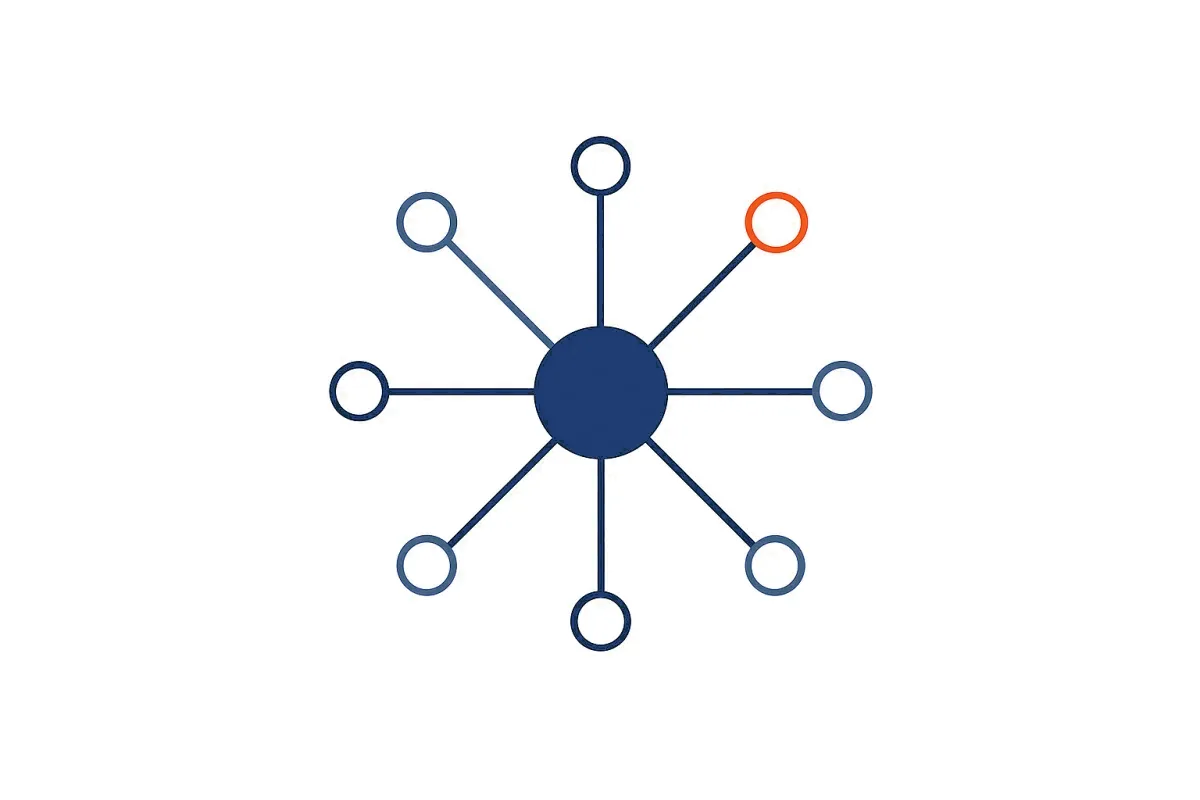
Awareness is built by repetition, and there is no way around that. You may have heard of the rule of seven, which says a buyer needs to encounter you seven times before acting. I would not treat the number as science; it comes from old advertising folklore, and I have never seen it traced to a study. The principle underneath is sound, though. One exposure is forgotten by the weekend. A name seen repeatedly, over months, in the same context, starts to feel like a name the buyer has always known.
The trap is that repetition of self-promotion is intolerable. "We helped a client achieve great results" said seven times is noise by the third, and the buyer quietly stops reading. This is where most small firms give up: they sense that repeating themselves is annoying, so they stop, and the awareness they were building evaporates.
The way out is to repeat an opinion rather than a claim. Choose one point of view about your buyer's problem, the kind a reasonable person could argue with, and say it from a different angle every week. A story from a project one week. A mistake you see everywhere the next. A question a prospect asked, and how you answered it. Each piece teaches something, so each repetition arrives as a small gift rather than a small advertisement. The buyer does not experience it as being sold to. They experience it as a consultant who has been paying attention to their problem for a long time.
I have been saying that a sales problem is usually a marketing problem in more ways than I can count. Every article on this site is that one sentence, approached from a fresh direction. That is not a shortage of ideas. It is what awareness building looks like from the inside, and the repetition that has long since bored me is still new to the person reading it for the first time.
This is the same machine I described in brand building for professional services: a point of view, developed into a body of work, attached to a name. Awareness is that machine pointed at a named list. The rhythm that sustains it is modest, one idea a week and one developed piece a month, and I have written about keeping that up without burning out. The founders who fail here are rarely the ones who post too little. They are the ones who post about themselves.
When Paid Visibility Is Worth It (and When It Is a Bonfire)
None of this means paid visibility is always wrong. It means paid visibility amplifies; it does not create. If there is nothing worth amplifying, the money burns cleanly and leaves nothing behind.
Paid is worth it when three things are already true. You have a positioning decision and a message that has been tested on real prospects, so you know what to say. You have a narrow list, so the spend can be pointed at the hundred rather than at the country. And you have a specific job for it: keeping your name in front of the list between organic appearances, putting one developed article in front of the exact companies on the sheet, or sponsoring the one association event the hundred attend. Used that way, ₹1 lakh does the work of a year of cold introductions, because it lands on people who are already half aware of you.
Paid is a bonfire when it substitutes for any of those things. A firm without a position buys reach among people who cannot tell it apart from its competitors, and pays to be forgotten faster. A firm without a body of work sends clicks to a site that gives the visitor nothing to read, so the click confirms nothing. And a firm that buys broad reach, the campaign from the pitch I began with, pays consumer-brand prices to be seen by people who will never buy. The rule I give founders is plain: earn the awareness organically among the first twenty on your list, learn what works, and only then spend to speed up the next eighty.
How to Measure B2B Brand Awareness in a Small Firm
The measurement follows directly from the list, which is the great advantage of the list. You do not need brand-tracking studies, and impressions and follower counts are the wrong instruments. Once a quarter, go down the hundred and count four things:
- Known. How many would recognise your name and say what you do? This is the number you are moving.
- In contact. How many have you connected with, exchanged a message with, or met, however briefly?
- Engaged. How many have read, replied to, or commented on something you published in the last quarter?
- Enquired. How many have asked about working with you, without an introduction?
Alongside the list, watch two signals in the enquiries themselves. The share of enquiries that arrive with no referrer at all, which for most firms starts near zero and should climb. And the sentence "I have seen your posts" or "I read your piece on", which tells you the awareness did its work before you were in the room.
Awareness among a hundred named buyers moves in visible steps: three known becomes twelve, twelve becomes thirty. Expect the first movement within a quarter of showing up consistently in the right places, and expect it to take a year or more before the list is mostly familiar with you. The pace depends on how narrow the list is and how regularly you appear, far more than on how much you spend.
Awareness Sits in the Middle of the System
Brand awareness is not a strategy on its own, and treating it as one is how firms end up with a following and no pipeline. It sits in the middle of a larger system for getting clients beyond referrals. Upstream of it is positioning, which decides who the hundred are and what you want them to know. Downstream of it is lead generation, which turns familiarity into conversations and conversations into work. Awareness is the part that makes the downstream part cheap, because a buyer who already knows your name needs far less convincing.
Get the order right and a small firm can become known to every buyer who matters to it without a media plan. Get the order wrong and no budget is large enough.
Visible to your referral circle, invisible beyond it? Get in touch. Tell me who your buyers are and where your last ten enquiries came from, and I will tell you honestly whether the gap is awareness, positioning, or something else. If it needs a closer look, the usual first step is the Pipeline Reality Check, a one-week diagnosis of where new business really comes from.

About the Author
Anoop Kurup
I'm a marketing consultant for B2B service firms in India. I fix the positioning, visibility, and lead generation behind weak sales. Before this: a research lab at GE, then patents and competitive strategy, then an intellectual-property firm I built and exited. I work with founders one engagement at a time from Bangalore.
More about meCLEAR · Engage
Visible to your referral circle, invisible beyond it?
Tell me what you're seeing in your pipeline. I'll tell you honestly if I can help, and where I'd start.
Get in touch