
Client Acquisition System for Service Businesses
A client acquisition system is the repeatable way B2B service firms win clients without depending on referrals. Here is how to build one.
Every B2B service firm I have ever worked with can tell me, in detail, how they deliver their work. Ask how they get their clients, and the room goes quiet. The honest answer, once we dig, is usually some mixture of referrals, luck, an old client resurfacing, and the founder pushing hard whenever the pipeline looks thin.
That mixture is not a system. It is a set of happy accidents that have repeated often enough to look like one. And the difference between the two decides almost everything about how the firm grows: whether revenue is predictable or lumpy, whether the founder can ever step back, whether a slow quarter is a scheduling blip or an existential fright.
This page is my attempt to lay out the whole machine in one place: what a client acquisition system is, why most service firms never build one, what its five parts are, and how they connect into something you can actually run in a working week. It is long, deliberately. The linked articles go deeper on each part.
What a Client Acquisition System Actually Is (and Is Not)
A client acquisition system is the repeatable set of activities that takes your firm from "stranger who has the problem" to "client who has paid", on purpose, without depending on referrals or the founder's spare time. In plainer words: it is the way your firm gets clients, written down, running weekly, and owned by the business rather than by luck.
The word doing the work in that definition is repeatable. A system produces its result again and again from the same inputs. If your firm won its last five clients five different ways, none of which you could do again deliberately, you do not have a system; you have a history.
It is worth being equally clear about what a client acquisition system is not, because the term attracts baggage.
It is not a funnel. Funnels, in the software sense, are volume machines: thousands in at the top, automation in the middle, a small percentage out the bottom. A firm that needs fifteen good clients a year has no use for that shape. Your numbers are small, your sale is built on trust, and every serious prospect expects to talk to a human. The system I am describing produces qualified conversations, not traffic.
It is not a tool. No CRM, no automation platform, no AI assistant is the system. Tools store and speed up the system once it exists. Buying tools before the system exists is how service firms end up with a subscription graveyard and an unchanged pipeline.
And it is not a growth hack. There is nothing clever in it. Every part is mundane, which is precisely why it works: mundane things can be repeated by ordinary busy people, week after week, which is the entire game.
Why Service Firms Stall: The Three Missing Pieces
When a service firm's growth flattens, the diagnosis is nearly always some combination of three conditions. They reinforce each other, which is why firms rarely escape by fixing one alone.
The first is referral dependence. Referrals are wonderful clients and a terrible strategy, because every one of them arrives on someone else's initiative and someone else's timing. A firm running on referrals has outsourced its future revenue to the goodwill and memory of people it does not manage. The feast-or-famine revenue curve that most service firms treat as normal is simply what that outsourcing looks like on a graph. I have written a full piece on how to stop relying on referrals, and the short version is: keep them, and stop needing them.
The second is founder-led sales. In most firms the founder is the only person who can qualify a prospect, tell the firm's story, and close a deal, which means the pipeline moves only when the founder has time, and the founder's time is the most oversubscribed resource in the building. Sales stops whenever delivery surges, which manufactures the next famine on a three-month delay. The knowledge that makes the founder good at selling is real, but most of it can be extracted and shared; the founder-led sales trap covers how.
The third is the absence of a weekly rhythm. Ask a stalled firm what marketing and sales activity happened in the last fortnight, on purpose, on schedule, and the answer is usually nothing; things happen in bursts, when someone panics or a slow month concentrates the mind. Pipeline activity done in bursts produces revenue in bursts. There is no trick that converts sporadic effort into steady clients. The rhythm is the mechanism, and it is the piece firms most consistently lack.
Notice that none of these is a talent problem. The firms I am describing are usually excellent at the work itself. They stall because the getting-of-clients was never engineered with a tenth of the care that delivery gets. That is good news, in a way. Engineering problems have engineering solutions.
The Five Parts of the System
Every working client acquisition system I have seen or built has the same five parts. In my own practice they map onto the letters of CLEAR, the engagement I run, but the parts are universal; call them what you like as long as all five exist.
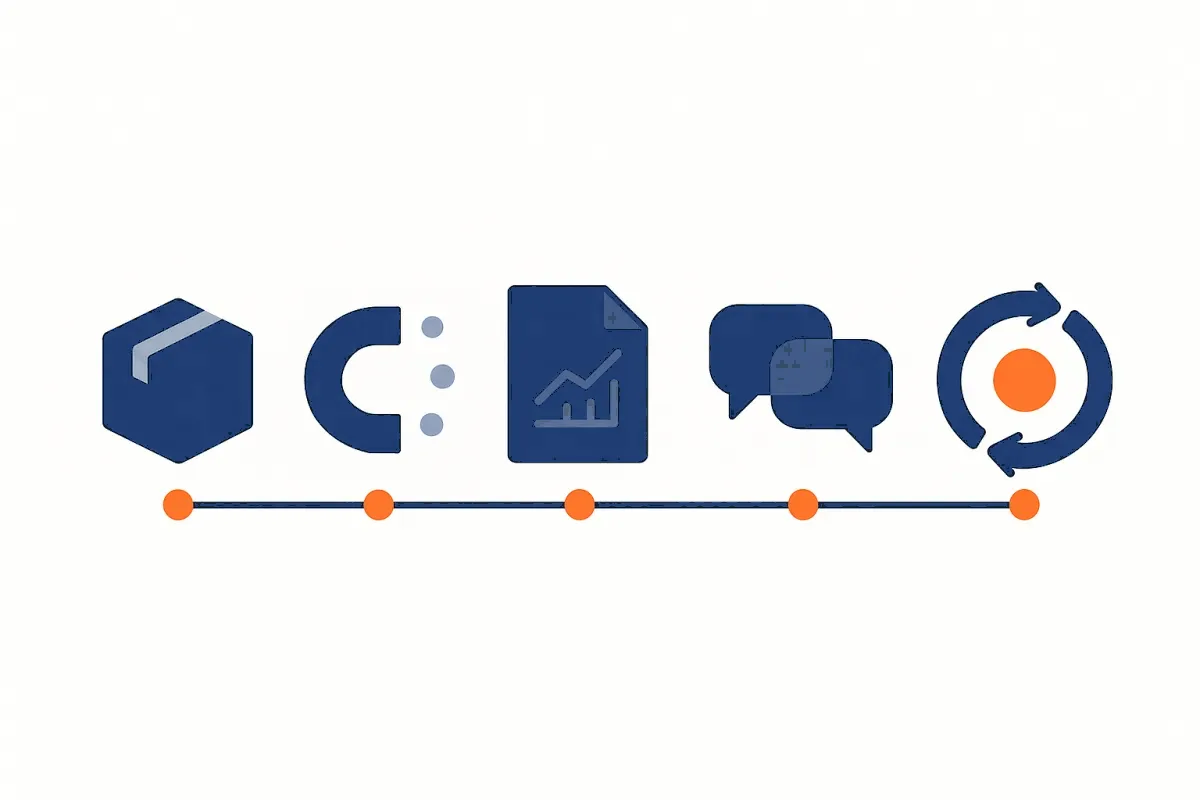
Clarify: one offer, sharply positioned. The system starts with what you sell, because every downstream part points at it. That means one packaged offer: a named engagement with a defined scope, outcome, price, and timeline, aimed at one clearly described kind of client with one expensive problem. Firms resist this, fearing narrowness will cost them work. In practice the packaged offer is the front door, custom work continues behind it, and the sharpness is what makes every message, list, and conversation easier. The mechanics are in how to productise your service.
Lead: a deliberate flow of the right prospects. With the offer clear, lead generation stops being "do marketing" and becomes something bounded: maintain a named list of the organisations that fit, work your warm network with specific asks, publish weekly where your buyers look, and reach out directly, in small researched batches, to the list. No ads, no funnels, no volume machinery; those solve a different business's problem. What this looks like in a founder-sized week is covered in lead generation for service firms.
Engage: proof and follow-up that build trust while you sleep. Between "heard of you" and "ready to buy" sits a long quiet stretch where B2B deals are actually won and lost. This part of the system is the machinery of trust: case studies with real numbers, published thinking that demonstrates judgement, and, above all, disciplined follow-up. Most service firms lose more revenue to silence after a good meeting than to any competitor. A follow-up cadence owned by the system, rather than by the founder's memory, is the cheapest revenue increase available to almost every firm I meet.
Acquire: a sales conversation that is documented and repeatable. The close, in a services business, is a structured conversation: qualify honestly, understand the problem, propose the fit, state the price plainly, and ask. The system's job is to make that conversation a documented process, with a qualification checklist, the stories that carry proof, and rules for scope and price, so that it can eventually be run, at least in part, by someone other than the founder, and so that every deal teaches the firm something instead of vanishing into one person's experience.
Retain: turning delivered work into the next client. The most under-engineered part in almost every firm. Existing clients renew, expand, and refer, but only reliably when there is machinery for it: a review rhythm during delivery, a defined moment where results are documented into a case study, and a specific, unembarrassed way of asking for introductions. Every finished project should leave behind an artefact that makes the next sale easier. Firms with this part built grow quietly even when the front of the pipeline has a slow month.
Five parts. None is exotic. The system is not the sophistication of any one part; it is the fact that all five exist, connect, and run.
How the Parts Connect Into a Weekly Rhythm
A diagram of five parts is still not a system. The system is those parts running on a schedule, and for a founder-run firm the schedule that survives contact with reality is weekly, small, and protected.
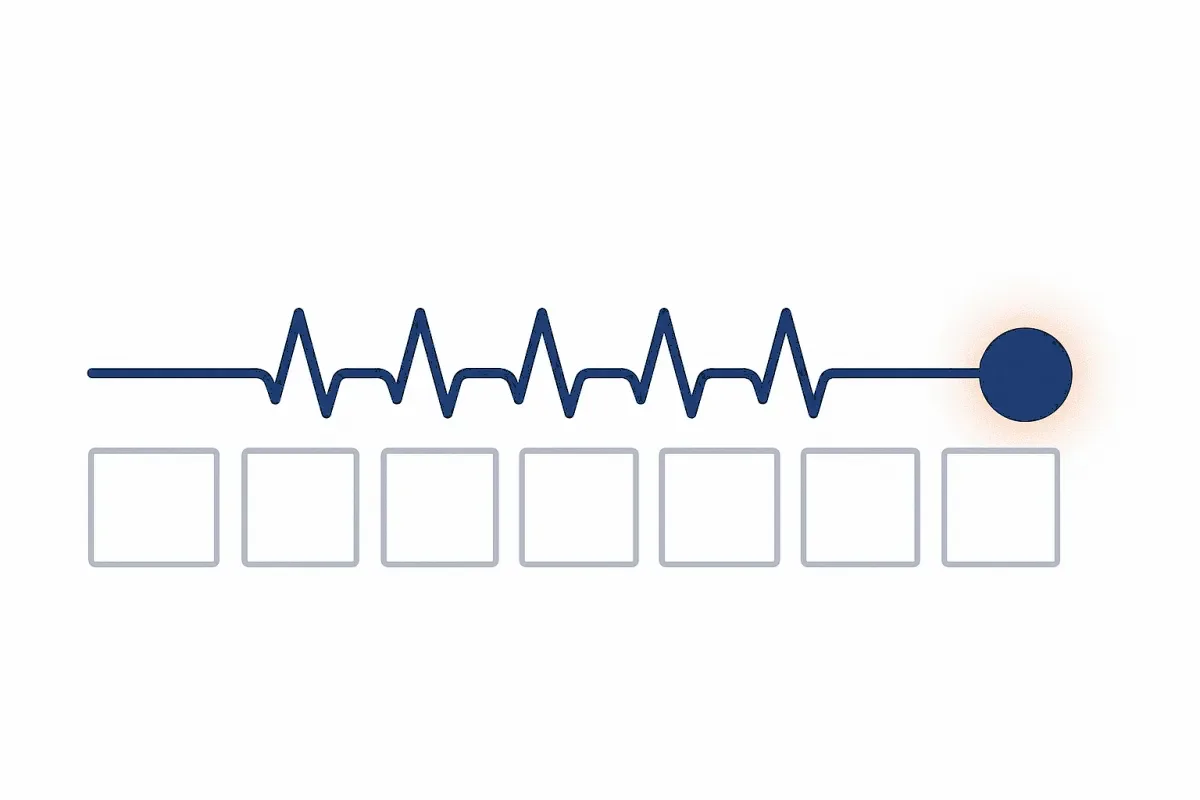
Here is the shape I install, typically two to three hours a week in total, held in the calendar like a client meeting because it is one, with your future clients.
A short pipeline review to start the week: every open conversation on one page, with what happens next and who does it. Fifteen minutes. This is the step that catches the silent leaks, the proposal sitting unanswered, the warm prospect nobody has written to in three weeks.
One block of outbound: a handful of researched, specific messages to people on the named list, plus the follow-ups the review surfaced. Not a campaign. A rhythm, boring and reliable, producing a steady trickle of new conversations.
One piece published: a single useful post drawn from real work, because visibility compounds and because every prospect you ever meet will look you up before replying.
And once a month, an hour on the slower gears: updating a case study, refreshing the list, asking one past client for a specific introduction, reviewing which messages actually earned replies and adjusting.
Individually these look almost trivially small, and that is the point. The feast-or-famine cycle is not caused by firms doing too little in total; it is caused by activity that stops whenever delivery gets busy. A rhythm this size does not have to stop. It fits inside the busiest month, so the pipeline never goes dark, so the famine never gets manufactured. Consistency is not one virtue among many here. It is the entire mechanism.
Run this rhythm for two quarters and something changes in the firm's posture that is hard to convey until it happens: negotiations stop being desperate because there are other live conversations, pricing firms up, the founder starts refusing poor-fit work, and revenue starts arriving because of things you did, on dates you can point to. That is what owning your pipeline feels like from the inside.
Where Most Firms Should Start
Faced with five parts, the instinct is to start with lead generation, because more leads sounds like more revenue. It is usually the wrong first move. Pour leads into a firm with a vague offer and no follow-up discipline and the extra leads simply leak through the same holes, faster.
The right starting point is whichever part is currently the constraint, and the constraint differs from firm to firm. A firm with a sharp offer and no conversations has a Lead problem. A firm with plenty of meetings and few closes usually has a Clarify or Acquire problem. A firm that closes well but rides the revenue rollercoaster almost always has a rhythm problem. Fixing the constraint moves everything; fixing anything else moves numbers on a dashboard.
Which is why the honest first step is a diagnosis rather than a purchase. If you want the weakest part of your system located and named, get in touch and tell me what you are seeing. I will tell you honestly where I would start.
From there, the path I take with firms is deliberately incremental: first the offer, because everything points at it; then the break from referral dependence via a named list and warm-path work; then lead generation as a weekly rhythm; then extracting the sale from the founder's head so the machine can eventually run without its inventor. For firms that want this installed rather than described, that is the consulting work I do, working alongside you on real prospects. But the system above is not a secret, and a determined founder can build a good deal of it alone.
If you run an advisory or consulting practice, where buyers judge the people because they cannot judge the work in advance, the same system is applied to your kind of firm in marketing for professional services firms. If you run a marketing, creative or digital agency, the agency version is in lead generation for marketing agencies. If you run a corporate training or coaching firm, where programmes are bought as topics and compared on day rate, the training version is in marketing for corporate training companies.
What no firm can skip is the decision underneath it all: that getting clients is a discipline to be engineered, not weather to be endured. Firms that make that decision stop asking "where will the next client come from?" It becomes a question with a boring, wonderful answer: from the system, same as the last one.
Common questions
What is a client acquisition system?
It is the repeatable set of activities that takes your firm from stranger to paying client on purpose: one packaged offer, a deliberate flow of right-fit leads, proof and follow-up that build trust, a documented sales conversation, and machinery that turns delivered work into the next client. Written down, running weekly.
How is client acquisition different from lead generation?
Lead generation is one part of the machine: producing conversations with the right prospects. Getting clients is the whole journey, from the offer those leads are shown, through follow-up and the sales conversation, to renewals and introductions after delivery. More leads fix nothing if the other parts leak.
How much does it cost to build a client acquisition system?
Built yourself, the cost is mostly discipline: two to three protected hours a week for a couple of quarters, and almost no tooling. If you want it installed with an experienced hand, that is the consulting work I do; engagements are scoped after a conversation.

Anoop Kurup
I'm a marketing consultant for B2B service firms in India. I fix the positioning, visibility, and lead generation behind weak sales. Before this: a research lab at GE, then patents and competitive strategy, then an intellectual-property firm I built and exited. I work with founders one engagement at a time from Bangalore.
More about meSee which part of your system is weakest.
This is the Engage stage of the CLEAR method. Tell me what you're seeing in your pipeline. I'll tell you honestly if I can help, and where I'd start.
Get in touch