
Why Founder-Led Agencies Stop Scaling: A Structural Problem, Not a Market One
Founder-led agencies plateau between year 10 and 15 not because of market conditions, but because the commercial architecture never grew up. Here's the fix.
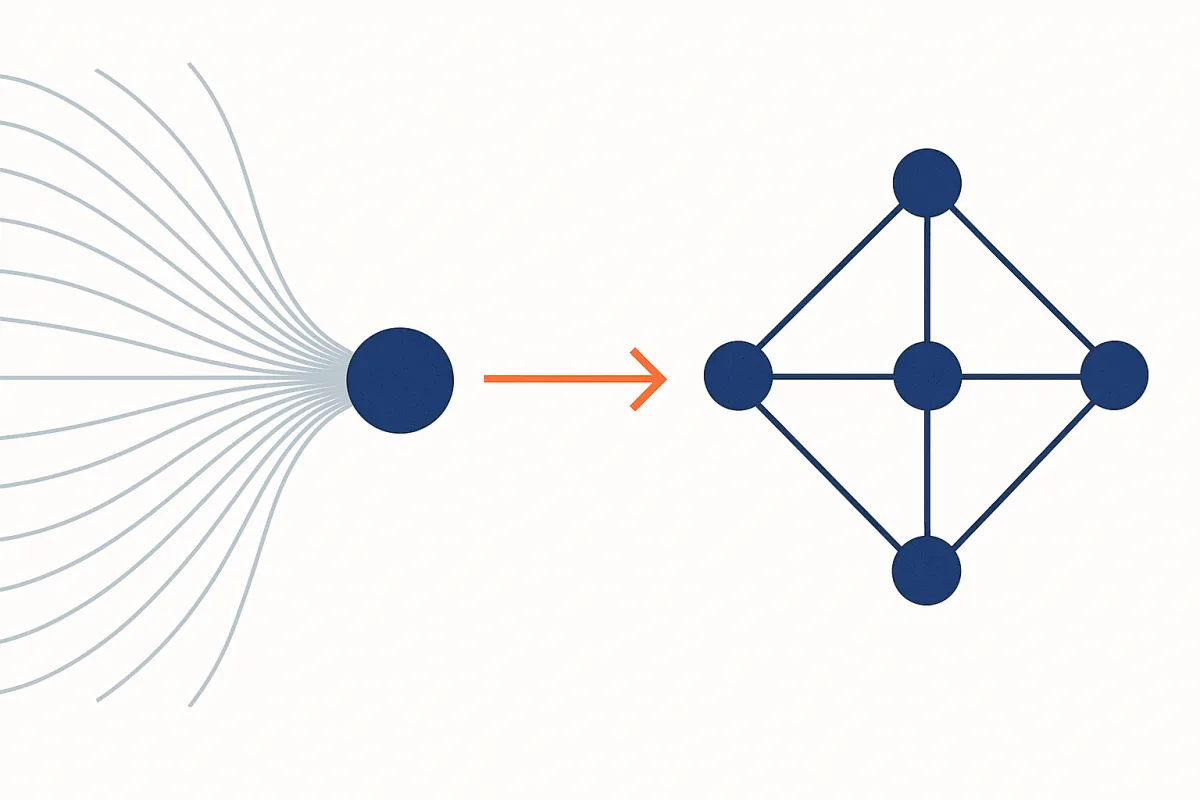
Most founder-led agencies hit a revenue ceiling somewhere between their tenth and fifteenth year. The work is good. The reputation is intact. Referrals keep coming. But revenue plateaus, margins compress, and the founder ends up more stretched than they were five years ago.
The usual diagnoses are a tougher market, younger competition, price pressure. Real, but not the root cause. The root cause is structural: the agency is still being sold the way it was sold when it had three clients and a laptop.
This article walks through what that structural problem looks like in practice, what it costs the business each year, and the specific shift that needs to happen for a mature founder-led agency to break through its ceiling.
The Sales Routine That Never Got Replaced
When an agency is new, every pitch is custom. Every deck is built from scratch. Every scope is negotiated from zero. The founder is the salesperson, the strategist, and the reassurance all at once. That mode of selling works; it's how the first hundred clients get closed.
The problem is that it never gets replaced.
Twenty years later, the agency has grown a team, added service lines, sometimes spun up sister brands, picked up international clients. But the sales routine looks identical to year one. Custom deck. Custom scope. Custom price. Every single time.
If you run a mature agency, the symptoms are recognisable:
- A senior partner builds a fresh pitch deck for almost every serious prospect: 30, 50, sometimes 70 slides, tailored to that one buyer.
- Prices are quoted with a range or "depending on scope" rather than a defined number. Two similar clients pay very different fees for comparable work.
- Sales conversations keep drifting into philosophy: brand-as-design versus brand-as-change, purpose-first versus execution-first. There's no concrete offer to anchor the discussion.
- The firm has built multiple sister brands or service lines over the years, each with overlapping capability, and no one outside the firm can clearly tell them apart.
- Scope expands after the contract is signed, because what was sold was an outcome, not a defined set of deliverables.
These are not isolated quirks of how the firm operates. They are signals of a single structural issue: the commercial architecture has not evolved with the firm.
What This Pattern Actually Costs
Selling like a boutique isn't free. It has specific, measurable costs, most of which the founder absorbs personally, which is exactly why they go unnoticed.
1. Senior Time Burned on Spec Work
A custom 50-slide pitch deck takes 8–15 hours of senior time to produce. If a firm sends ten of these in a year and closes three, that's 80–150 hours of partner-level work absorbed into deals that never happened. At partner day rates, that's a hidden six- or seven-figure annual cost most agencies have never put on a spreadsheet.
2. Sales Cycles That Drag
When the offer is negotiated for each prospect, the sales cycle stretches. Every proposal triggers a new round of scoping calls. Every scope change requires re-pricing. A deal that should close in 30 days closes in 90, and the close rate drops because prospects cool while the agency is still customising the pitch.
3. Pricing Power That Leaks
"Fees upwards of X lakhs depending on scope" is a line that reads as flexible but lands as negotiable. The buyer hears: the price is fluid, and if I push, it'll move. It does. Across a year, firms with undefined pricing routinely under-quote comparable work by 20–40% depending on who's sitting across the table.
4. A Team That Can't Be Handed the Sale
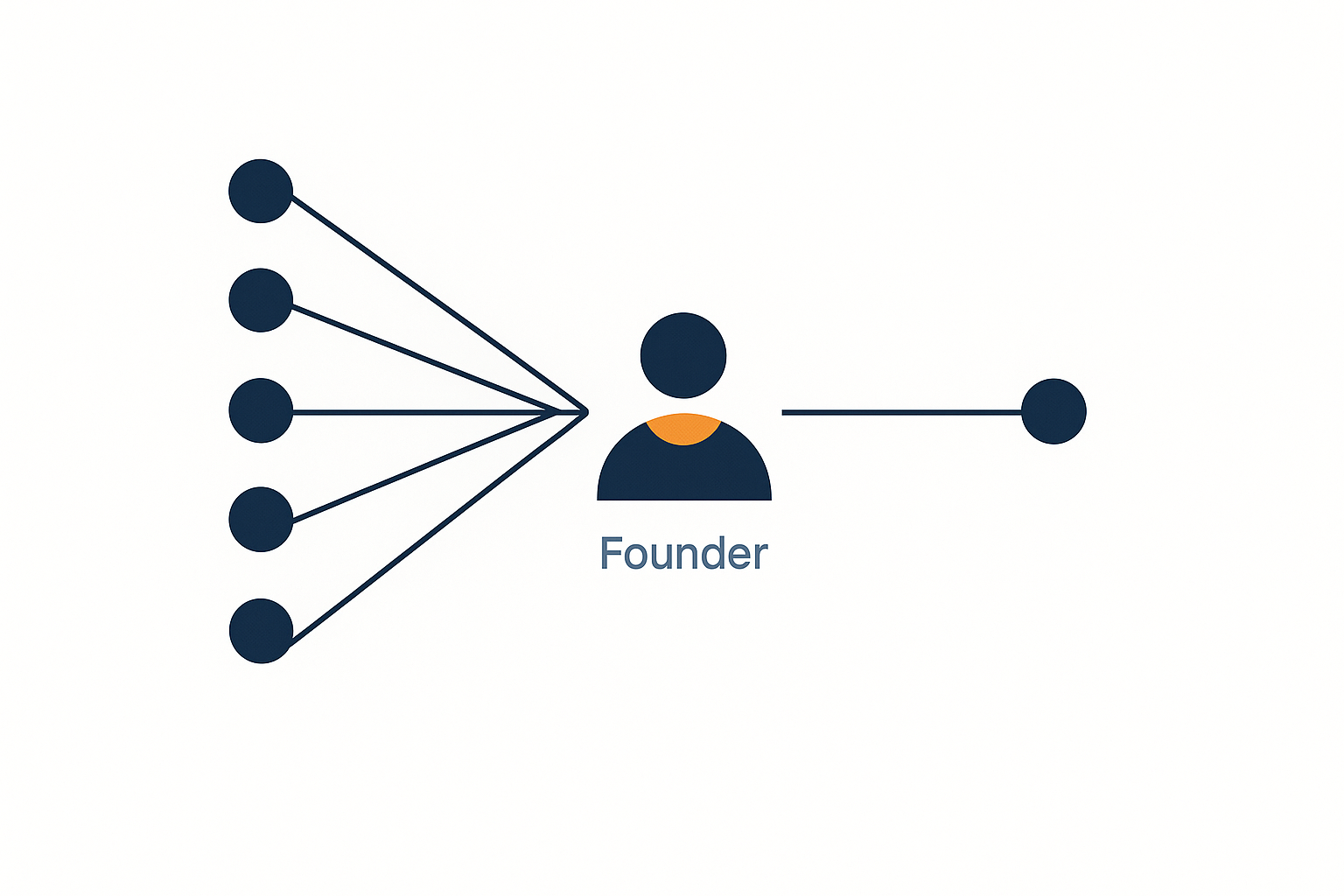
When the offer lives in the founder's head and gets built fresh each time, it cannot be delegated. A junior team member can't close. A senior hire can't be trusted with a pitch. The founder remains the single point of sale long after they should have stopped being one, which caps the firm at whatever the founder can personally close in a year.
5. Sister Brands That Compete With Each Other
Agencies that have built multiple entities over time often discover that none of them has a distinct, buyable offer. A strategy arm, a design arm, a digital arm, a martech arm: they all do "brand work." Internally the team knows the difference. Externally, the prospect doesn't, and the three brands end up pitching the same scope to the same buyer through different doors.
6. Delivery That Exceeds Scope
When what gets sold is a transformation, delivery is open-ended. The team delivers until the client is satisfied, because there's no line in the contract that says what "done" looks like. Margin erodes quietly. Projects priced for three months run to five. The team burns out and the firm's profitability on paper never matches the profitability on the ground.
The cumulative effect is exact: a 20-year-old agency ends up with the revenue ceiling of a 5-year-old one. Not because the work isn't good; the work is usually excellent. It's because the commercial architecture around the work never evolved past the early-stage version.
Why This Doesn't Get Fixed
Here's the uncomfortable part: the reason this doesn't get fixed is that the founder is good at what they do.
When the current sales routine is customising every pitch, and the founder happens to be a world-class strategist, the pitches convert. Not at the rate they should, but well enough that the pain never becomes acute enough to force change.
Every year the firm closes enough deals, through custom-built decks and founder-led sales, to keep the doors open and the team paid. The shortfall against what the firm could be is invisible, because there's no counterfactual. You don't see the deals that never closed because the sales cycle was too long. You don't see the fees you should have commanded because the pricing was negotiated. You just see the deals that came through.
This is why most founder-led agencies will spend the next decade in exactly the same position as the last one, unless something forces a structural shift.
The CLEAR Framework: From Service to Offer
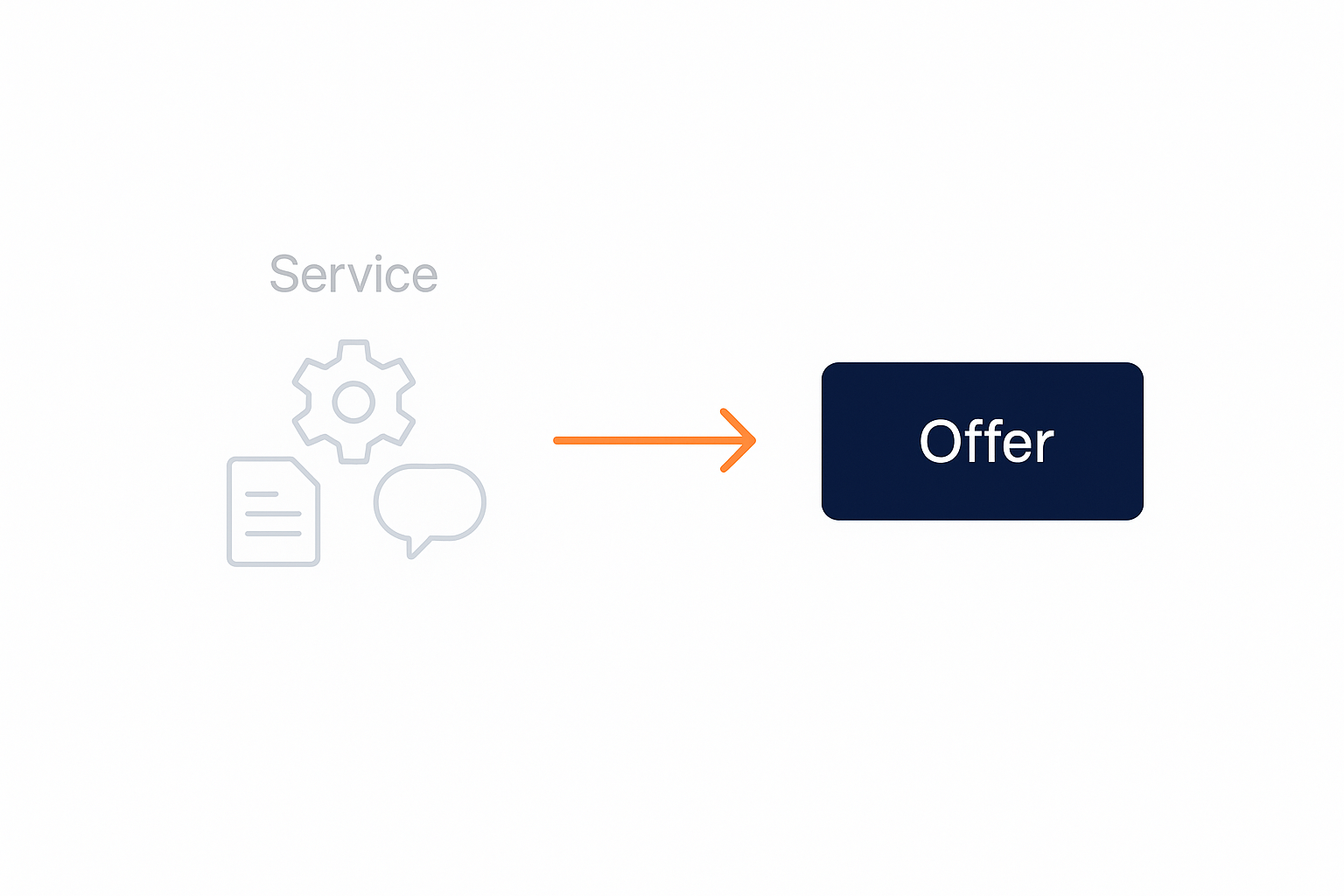
The shift is not about commoditising the work. The work stays as sophisticated, strategic, and bespoke in delivery as it always was. What changes is the commercial architecture around the work: the offer, the pricing, the sales routine, the ladder of engagements that sit alongside the flagship.
Five things need to be resolved, in a specific order:
C: Client Transformation. Who exactly the offer serves, and what tangibly shifts for them. Not the segment in the abstract, but the specific buyer profile and the named change in their business.
L: Line-Item Deliverables. What the buyer receives: named artefacts, not described outcomes. "Brand Strategy" is not a deliverable. "12-page Brand Strategy Document, presented in a 90-minute working session, with a 4-page Implementation Brief" is.
E: Execution Roadmap. How the work is delivered, and how the offer gets sold. The delivery process and the sales process are both part of the offer's design, not improvised each engagement.
A: Agreement Terms. The commercials, the boundaries, and the exit clauses. What's included, what's not, what triggers a change order, what happens if either party wants to step out.
R: Ready Extensions. What sits before, alongside, and after the flagship offer. Smaller entry offers that lower the barrier. Larger extension offers that grow the relationship. Together with the flagship, this becomes a ladder.
The output is not a brochure or a menu. It is a specific, named flagship offer, with a price, a defined scope, and a sales routine that doesn't depend on the founder building a custom deck each time. Around that flagship sit smaller entry offers and larger extension offers that form a ladder, so a prospect can enter the relationship at any point and move up naturally.
When this is done well, three things shift at once. The sales cycle compresses, because the offer is already defined and only the fit needs to be assessed. The partner's time stops being spent on spec work, because the pitch is built once and reused. And the pricing ceiling rises, because the buyer sees a defined product rather than a negotiable service.
The Diagnostic Worth Sitting With
For any founder-led agency that's been in the market long enough to have built a reputation: the capability isn't the limit. The commercial architecture around the capability is.
A useful diagnostic question: if the founder stopped personally selling tomorrow, how much of the current pipeline would survive?
If the honest answer is "not much," the issue isn't demand. It's that the offer has never been productised to the point where someone other than the founder can sell it, or where a prospect can buy it without being pitched.
That is a solvable problem. It is almost never a quick one.
If you're running a founder-led agency that has plateaued and you suspect this pattern is part of why, get in touch and tell me what you're seeing. I'll tell you honestly how much of the pipeline depends on you, and which part of the commercial architecture to fix first.

About the Author
Anoop Kurup
I'm a marketing consultant for B2B service firms in India. I fix the positioning, visibility, and lead generation behind weak sales. Before this: a research lab at GE, then patents and competitive strategy, then an intellectual-property firm I built and exited. I work with founders one engagement at a time from Bangalore.
More about meRelated reading
Scaling beyond the founder
How to Scale a Consulting Business Beyond You
Growth stalls when everything runs through the founder. Here is how to scale a consulting business by removing yourself from the parts that don't need you.
Getting clients beyond referrals
Founder Brand vs Company Brand in B2B Services
The founder's name opens doors the company name cannot. Here is how to use a founder brand without the business depending on it forever.
Positioning and pricing
Why Disqualifying Prospects Faster Generates More Revenue
For B2B service firms, leads are a quality problem, not a volume one. Here's why disqualifying prospects faster grows revenue, and the system to do it.
Still depending on referrals?
Tell me what's going on with your sales. I'll tell you honestly if I can help.
Get in touch