
The Praise Trap: Why Expert-Founders Get Admired But Not Paid
Many expert-founders have full calendars and empty pipelines. Here's why praise doesn't translate to revenue, and how to fix the boundary problem.
There is a particular kind of expert-founder business that looks healthy from the outside but is quietly under-performing. The founder is visible: speaking on panels, posting regularly, taking calls, doing podcasts. The feedback is warm. The inbox is active. The calendar is full. And the revenue is thin.
This pattern is common enough to have a name. I call it the praise trap. It specifically affects smart, articulate expert-founders such as consultants, CA firm owners, lawyers, and specialised advisors, because they are good enough at explaining their thinking that people enjoy the conversation without ever needing to pay for it.
If this describes where you are right now, this article is a way to diagnose what's happening and a practical path out.
Clients Vote With Their Wallet, Not Their Words
The first thing to say clearly: if someone praises your framework, your thinking, or your approach, but is not willing to pay, their praise is not a positive signal. It is a polite exit.
This can feel counterintuitive. Praise feels meaningful. It is specific, it is flattering, it references your actual work. But praise costs the person giving it nothing. It does not require them to change their calendar, reorganise their priorities, or allocate budget. The only feedback that signals real demand is a signed agreement.
I worked recently with a founder who had spent nearly four months doing what most people would call "business development." Speaking on industry panels. Recording podcasts. Taking long exploratory calls with people who reached out after seeing his work. The feedback he kept receiving was consistent:
"This is exactly how we've been thinking about the problem." "You've articulated this better than anyone else." "We should definitely explore working together."
Then we counted.
Thirty-plus conversations. Zero paid engagements.
He had built an audience. He had not built a clientele. And the positive reinforcement was pulling him further into the same behaviour while his cash flow kept thinning: more content, more calls, more exploratory mode.
The Free Advice Trap: A Second Version of the Same Problem
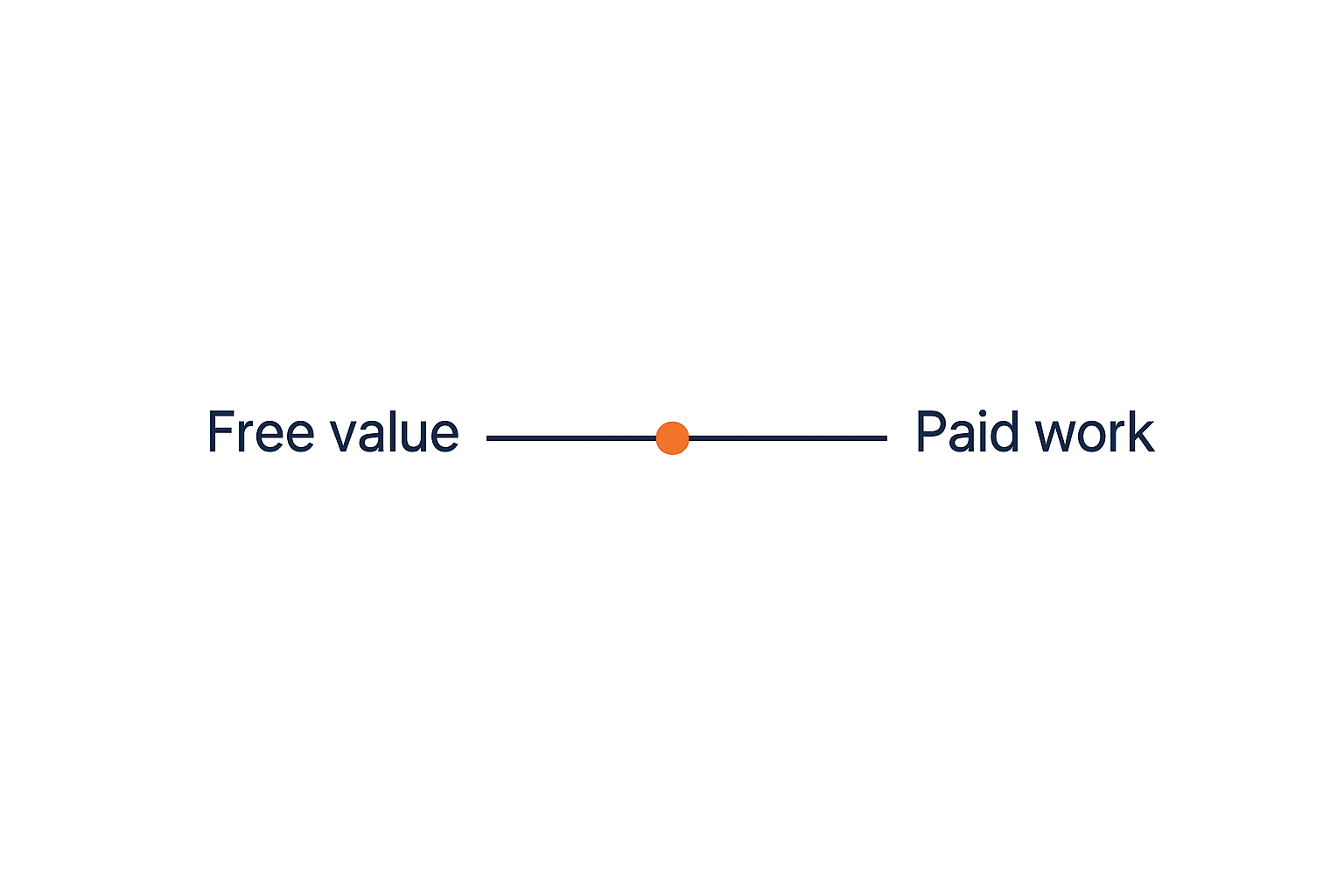
There is a second way this pattern manifests, and it shows up in founders who don't yet have a public platform. They don't have a podcast or a speaking schedule; they're trying to establish credibility within their own professional network.
These founders tend to overcompensate. They share frameworks quickly. They walk through their approach to demonstrate expertise. "Let me just show you how I'd handle this." Initially, this works. It builds credibility.
But then the calls get longer. The prospect starts expecting deeper advice in each subsequent meeting. In the worst version of this pattern, the prospect starts implementing the founder's thinking without ever hiring them, because they now have enough detail to execute on their own.
The founder, meanwhile, keeps hoping that demonstrating enough value will eventually convert. It rarely does. Because the prospect has been trained, by the founder, to extract value without paying.
Where the Line Actually Sits
Most founders cross the line from marketing to consulting without noticing. Here is the clearest way I have found to draw it:
If your input helps someone understand the problem, that's marketing. If your input helps someone solve the problem, that's consulting.
Marketing is free. Consulting is paid.
A useful rule of thumb: if the client can take your input and execute without you, you have already given away too much. The work of a paid engagement is not the diagnosis. It is the implementation, the judgement calls along the way, the adjustments when things don't go as planned. When you compress all of that into a free conversation, you have nothing left to sell.
Why Smart Founders Fall Into This
Three psychological factors typically operate below conscious awareness.
Ego. Praise feels good. Being seen as the most thoughtful person in the conversation is addictive. Each comment about how well you've articulated something is a small hit of validation, and the behaviour that produces those comments tends to repeat.
Fear of rejection. Asking for money introduces the possibility of a clear no. Staying in the "helpful and valuable" mode avoids that discomfort entirely. The conversation continues indefinitely, neither side ever committing. For the founder, this feels less risky than asking.
Relationship preservation. Many expert-founders are uncomfortable turning a friendly, intellectually engaging discussion into a commercial one. It feels like it changes the quality of the relationship. So they delay the ask. And they keep giving.
None of this is irrational. But the cumulative effect is expensive. The prospect is being trained to receive value without paying. Once that pattern is established, it does not reverse. The person who got free advice in month one does not suddenly pay in month seven; they have already internalised the implicit deal.
The Three-Metric Diagnostic
If you want to know whether you are currently in the praise trap, three numbers tell you most of what you need to know. Ask yourself about the last 30 days:
- How many paid conversations did you have? Not exploratory calls. Conversations that ended in a signed proposal or an active engagement.
- How many of your proposals turned into actual revenue?
- Of all the people who praised your work, how many also paid you?
If those numbers are close to zero, and especially if your calendar has been full during the same period, you do not have a demand problem. You have a boundary problem.
This distinction matters. A demand problem is solved by more marketing. A boundary problem gets worse with more marketing, because additional visibility just brings more unpaid conversations.
The Three Shifts That Break the Pattern
To step out of the praise trap, three behavioural shifts matter more than anything else:
Stop extending conversations without a clear next step. If a conversation is valuable, it either moves towards a proposal or it ends. "Let's stay in touch" and "let's keep talking" are not next steps. They are soft exits dressed up as continuity.
Stop giving away implementation-level thinking. Frame the problem. Name the diagnosis. Describe the category of work that would be needed. But do not walk through the solution in an unpaid call. If the prospect wants the solution, that is the paid engagement.
Start moving discussions towards a paid engagement earlier. Not at the end of a seven-call sequence. At the second or third call at the latest. A clear proposal is not rude; it is the actual invitation to work together. Delaying it is what makes it feel heavy.
These shifts feel uncomfortable when you first try them. They will reduce the volume of pleasant conversations in your calendar. That is the point. A smaller number of conversations that lead to paid work is substantially better than a large number of conversations that lead nowhere.
The Brand-Building Objection
The common pushback to this argument sounds like: "But free content and free advice is how I build my brand. If I stop being helpful, how do I grow?"
It is worth answering this clearly.
Free content builds awareness. It builds credibility. It creates inbound conversations. All of that is genuinely valuable, and I am not suggesting you stop.
But free content does not replace paid projects. And it should not become an excuse for avoiding the ask. The mistake most expert-founders make is confusing visibility with validation. A strong brand should make it easier to get paid, not harder to transition from admiration to engagement.
If people follow your content, praise your thinking, and still don't hire you, the problem is not your content. It is that the conversation never shifts from "this is interesting" to "let's work together." That shift requires an active move from you. It does not happen by itself.
If someone truly values your thinking, they will pay for access to it. If they don't, they were never a client to begin with, regardless of how much praise they gave you along the way.
The fastest way to improve your pipeline is usually not more marketing. It is tighter boundaries on the marketing you are already doing, and earlier, clearer moves towards paid work. That shift alone has changed more expert-founder businesses than any visibility strategy I have seen.
Not sure whether you have a demand problem or a boundary problem? Get in touch and tell me what you're seeing. I'll tell you where your pipeline is actually leaking, and what to fix first.

About the Author
Anoop Kurup
I'm a marketing consultant for B2B service firms in India. I fix the positioning, visibility, and lead generation behind weak sales. Before this: a research lab at GE, then patents and competitive strategy, then an intellectual-property firm I built and exited. I work with founders one engagement at a time from Bangalore.
More about meRelated reading
Positioning and pricing
A B2B Messaging Framework That Sells Services
A messaging framework for B2B services firms: what to say, in what order, so prospects understand what you do and why it is worth paying for.
Positioning and pricing
How to Differentiate a B2B Services Firm
When prospects cannot tell you apart, they choose on price. Here is how a B2B services firm builds real differentiation, beyond claiming quality.
Positioning and pricing
Positioning for Consulting Firms
Most consulting firms describe themselves the same way. Here is how to choose a position your market actually cares about, and own it.
Still depending on referrals?
Tell me what's going on with your sales. I'll tell you honestly if I can help.
Get in touch