
How Experts Should Pitch at Networking Events: Lead With the Problem, Not the Service
At a networking event, nobody buys a service they've just heard of. Lead with the problem instead. Here's what to say when someone asks what you do.

Most experts walk into networking events with a vague plan and walk out with a stack of business cards they will never use. This is not a failure of effort. It is a failure of approach. The defaults that most experts fall back on are designed to feel productive while producing very little: stating a title, performatively listening, exchanging cards.
There is a more effective way. It works in mixed rooms where your target market may not be present, and in rooms where it is. It is also one of the main reasons certain experts get referred consistently while others, often more skilled, do not.
This article covers the three default failure modes, the specific reframe that fixes them, and worked examples across several professions.
The Hidden Cost of Niching
Before getting to the reframe, it is worth naming why this matters.
Most experts hesitate to commit to a clear target market because they fear it will limit their relevance in mixed rooms. The thinking goes: if I focus on young urban families, what do I say at a general business event where most people don't fit that profile?
This hesitation is one of the main reasons experts stay generic. They keep their pitch broad, their service description vague, and their target market intentionally unclear, all in the hope that a wider net will catch more fish. It rarely does. A vague positioning does not help you in any room. It just makes you forgettable in all of them.
The fix is not to broaden your pitch. It is to change what you lead with.
Why Most Networking Defaults Fail
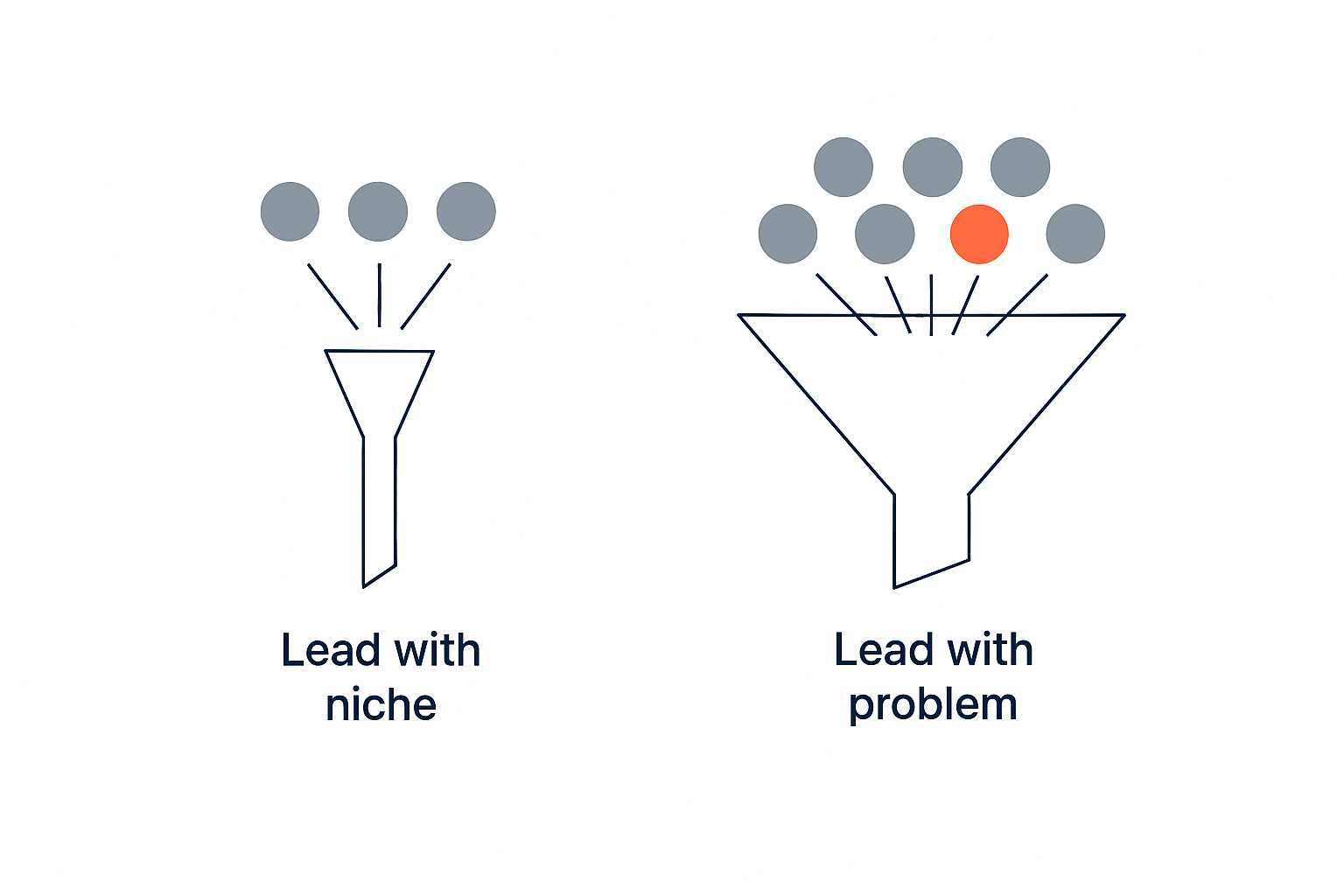
Watch how experts behave at networking events and you will see roughly three patterns repeated. None of them produce real connections, and they all fail for the same reason.
1. The Title Pitch
"I'm a marketer." "I'm an architect." "I do digital marketing." This is accurate, but it is closed. The conversation has nowhere to go unless the listener happens to need that exact service. Within two exchanges, the energy fades. Both people make polite noises and turn to whoever else is nearby.
2. Performative Listening
The expert lets the other person talk first. They nod, they ask surface questions, they appear engaged. But they are not really listening; they are waiting for their turn to deliver their own pitch. The result is two people delivering monologues with brief pauses in between, neither absorbing anything from the other. It looks like a conversation. It isn't one.
3. The Business Card Exchange
Brief introduction. Soft mention of a future call. Card swap. End of interaction. No common ground has been found. No real connection has been made. The card goes into a stack and is rarely looked at again. The expert congratulates themselves for "networking," but nothing has actually happened.
The thread running through all three failure modes is the same: the conversation is anchored to what each person does, not to what each person thinks about. Without a shared topic, there is nothing to genuinely discuss.
The Reframe: Lead With the Problem
The fix is to stop leading with your service and start leading with the problem that your service exists to solve.
The architect I worked with recently had committed to a clear target market: young urban families building or renovating homes. She was worried about how to introduce herself in mixed rooms. The answer was not to drop the focus. It was to talk about the problem her focus addresses.
Instead of "I'm an architect for young families," she could open with:
"Our living spaces haven't kept up with how we actually live now. Modern households need different things, and most homes aren't being built with that in mind."
That is a topic. Not a pitch. And the difference is significant.
When the conversation is about a problem rather than a service, more people join in. The topic is generic enough that they do not have to pitch themselves to participate, but specific enough that they have a point of view. They contribute. They share their own experiences. The exchange becomes a real conversation.
And here is what makes this work specifically for the expert who initiated the topic. The people in that room remember you as someone who understands a problem deeply enough to care, not as a generic version of your profession. The architect does not get filed in their memory under "architect." She gets filed under "the architect who thinks about how homes need to be designed differently for the way we live now."
That is a much easier thing to recall later. And a much easier thing to refer.
How This Looks Across Professions
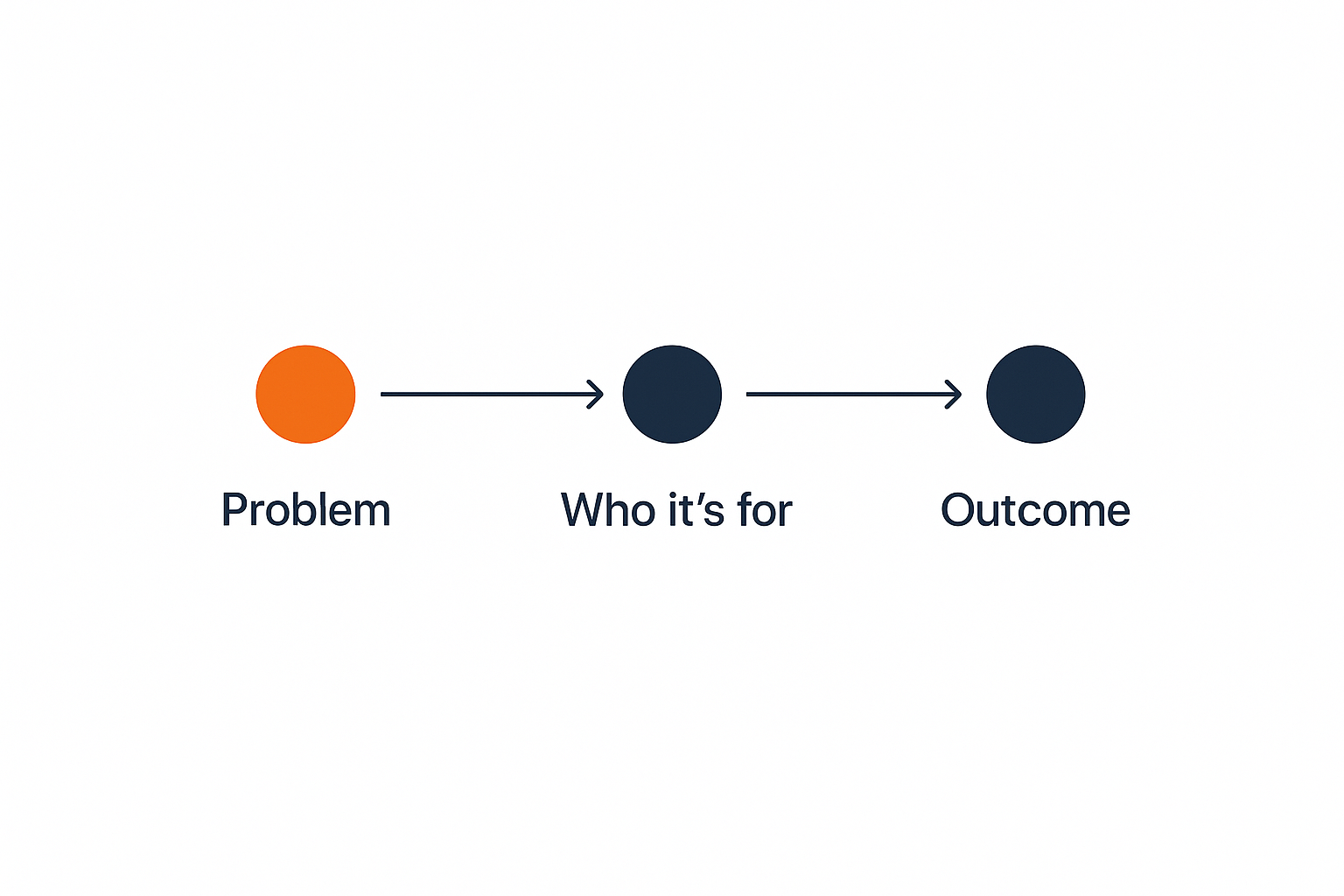
This shift works the same way for any kind of expert. The pattern is consistent.
Website designer. "I build websites" gets filed as generic. "Most service businesses have websites that act like brochures when they should be acting like sales engines" gets filed as a specialist in web assets that generate leads.
Digital marketer. "I do social media" is unremarkable. "Most experts have something valuable to say but no system for showing up consistently in front of the right audience" is the person who helps experts become thought leaders.
Retail growth specialist. "I work with brands" is unmemorable. "New products in retail have ninety days to prove themselves on shelf, and most launches fail because no one is solving for visibility in those first few weeks" is the person who secures shelf space.
Tax advisor. "I do tax planning" lands as transactional. "Most growing businesses are paying tax on profit they could have legitimately reinvested if they had structured their books differently in the first place" lands as a specialist in growth-stage tax structuring.
In each case, the expert is doing the same work they always did. What changes is how the room remembers them, and therefore who refers them later.
When to Use Which Version
A useful refinement: not every problem framing fits every room.
In mixed-audience events, lead with broad problems. This covers general business networking, industry-agnostic gatherings, and social-professional crossover events. The framing should be wide enough that anyone in the room can engage, even if they are not in your target market. The architect's "modern households need different things" works for developers, parents, real estate agents, builders, and investors. Each has a relationship to the topic.
Some rooms hold your actual target market: industry-specific events, peer gatherings, founder communities. There you can lead with sharper, more specific problems. Go deeper. Ask better questions. The principle is the same. The resolution changes.
In both cases, the rule about who is doing the talking matters more than people realise. Do not dominate. Initiate the topic, but participate in it. Let the room think with you, not at you. The expert who lectures gets tolerated. The expert who facilitates a conversation gets remembered.
The Underlying Principle
This is not really a networking tactic. It is a positioning principle.
The expert who is known for what they do gets compared to every other expert who does the same thing. The expert who is known for what they think about gets remembered as a specific expert on a specific problem. The first version competes on price and credentials. The second version gets referred.
When someone you met at a networking event later thinks "I know someone who thinks a lot about how homes should be built for modern families", that is the moment your positioning starts paying off. It does not happen because you handed them a business card. It happens because you gave them a context to remember you in.
The next time you walk into a room, do not open with what you do. Open with the problem your best clients are dealing with. Then notice who leans in. Those are the conversations worth having, and the ones that lead, weeks or months later, to the referrals that actually convert.
Not sure your positioning is sharp enough to lead with in any room? Get in touch and tell me what you're seeing. I'll tell you where your positioning and pipeline are costing you referrals, and what to fix first.

About the Author
Anoop Kurup
I'm a marketing consultant for B2B service firms in India. I fix the positioning, visibility, and lead generation behind weak sales. Before this: a research lab at GE, then patents and competitive strategy, then an intellectual-property firm I built and exited. I work with founders one engagement at a time from Bangalore.
More about meRelated reading
Getting clients beyond referrals
Marketing for AI Consulting Firms: Proof Over Hype
Every firm now claims AI. Buyers have seen pilots fail and cannot tell who is real. How an AI or data consulting firm earns trust before the first call.
Getting clients beyond referrals
Marketing for HR Consulting Firms: Known Before the Crisis
Companies call an HR consultant when something breaks, and they call the one they already know. How an HR consultancy gets known before that day.
Getting clients beyond referrals
Marketing for IP Firms: Getting Clients Beyond Referrals
Patent search, drafting and analytics firms do their best work under someone else's name. How an IP services firm gets known, from someone who ran one.
Still depending on referrals?
Tell me what's going on with your sales. I'll tell you honestly if I can help.
Get in touch