
Pricing Signals: What Your Rates Really Tell Prospects
Your rate is a message the prospect reads before you say a word. Here's what a low number actually tells them, and why raising it alone won't fix anything.

You're in an unfamiliar town and a tooth starts to hurt. Two clinics on the same street. One charges ₹300 for a consultation, the other ₹1,500. You know nothing about either dentist. No referral, no reviews you trust, no way to inspect the work before it's done in your mouth.
Which door do you walk through?
Most people hesitate at the ₹300 one. Not because they can't afford the other, and not because they think expensive automatically means better. They hesitate because the price is the only piece of information available, so they read it. A dentist charging ₹300 in a town where everyone else charges ₹1,500 has told you something about himself, and you weren't able to stop yourself from hearing it.
Your prospects are standing on that same street.
Your Price Arrives Before Your Reasoning Does
Here is what most expert-founders get wrong about pricing. They treat the number as the last step: the thing you calculate after the positioning is decided, the case studies are written and the proposal is built. Something to be worked out, sensibly, once the real work of persuasion is finished.
But for the person on the other side, the number is often the first thing that lands. It arrives before your methodology, before your track record, before the thoughtful explanation of how you'd approach their problem. And once it lands, it colours everything that comes after it. They are not reading your proposal and then noticing the price. They are reading the price and then interpreting your proposal through it.
This is not prospects being shallow. It is prospects doing exactly what you do at the dentist's door. Professional services are almost impossible to evaluate before you buy them. You cannot test-drive a strategy engagement. You cannot open the box and check the parts. So the buyer reaches for whatever signal is available, and price is the clearest one on the table.
Every quote you send is a statement about how you see your own work. You don't get to opt out of making that statement. You only get to choose what it says.
Cheap Talk and Costly Signals
There is a useful distinction from game theory that explains why this happens, and it is worth sitting with for a minute.
Some claims are cheap to make. Saying "I'm a strategic partner, not a vendor" costs you nothing. Anyone can say it. The consultant who is genuinely a strategic partner says it, and so does the one who will take any brief that pays this month. Because the words are equally available to both, the words carry almost no information. Economists call this cheap talk, and experienced buyers have learned to discount it heavily, even if they've never heard the term.
Other claims are expensive to make. A price is one of them. If you quote ₹4,00,000 for a piece of work, you have committed to something with consequences. You've accepted that a chunk of the market will now walk past you. You've accepted that the client will expect a standard of thinking that matches the number, and will say so loudly if it doesn't arrive. You've made a claim you have to live with.
That cost is precisely what makes the price believable. The buyer knows the person who can't deliver at that level generally can't hold that number for long; the market punishes it. So the number gets trusted in a way the words never will.
Which produces the situation I see again and again. A founder has spent months getting the positioning right, sharpening the language, building the case studies. Then the proposal quotes an hourly rate that would be unremarkable for a freelancer with two years' experience. The website says strategist. The number says contractor. The prospect believes the number, because the number is the only part of that proposal that cost anything to say.
The Three Things a Low Number Says
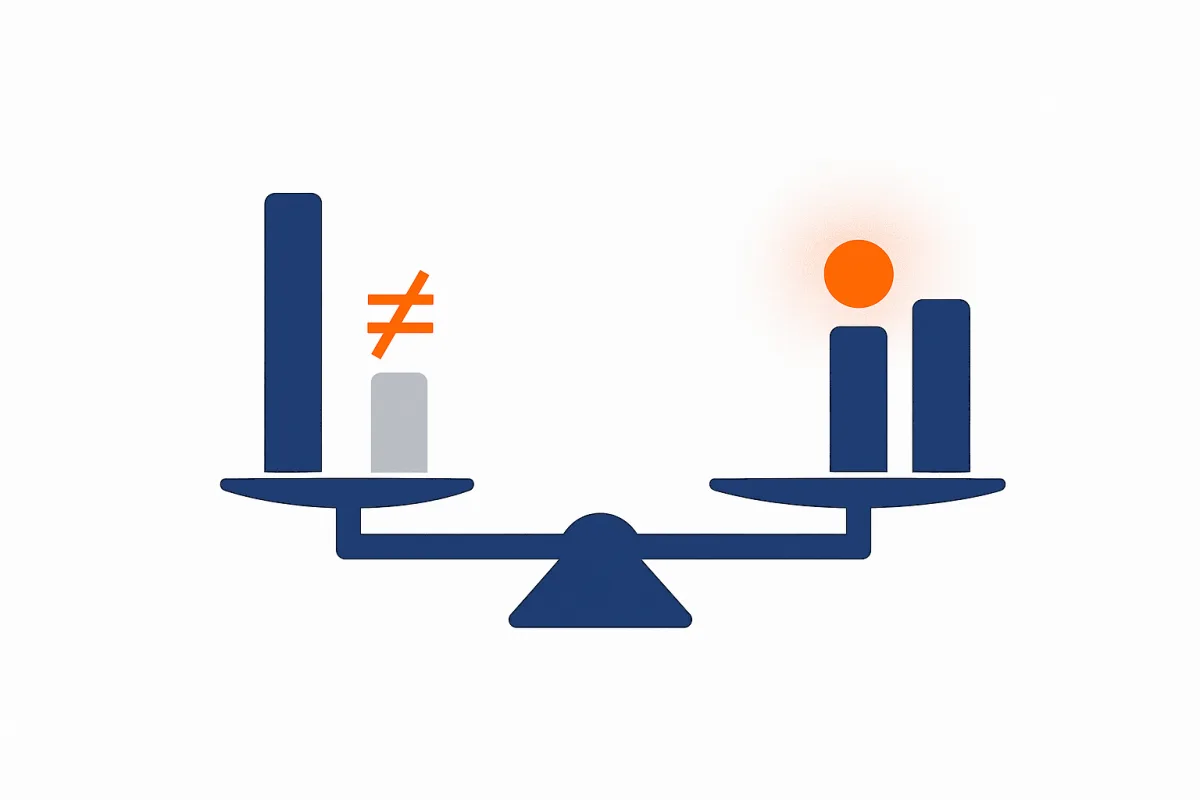
When your rate sits well below what your market pays, prospects don't hear "good value". Value is a conclusion they reach later, if at all. What they hear first is one of three things, and none of them are what you intended.
Nobody has asked me to solve a harder problem. In expert work, price and problem-size travel together. Someone who has repeatedly been trusted with expensive problems has a rate that reflects it, because that is what happens to people who keep being asked. A low rate suggests, fairly or not, that the hard problems haven't come your way yet. The buyer isn't judging your intelligence. They're guessing at your history.
Working with me carries risk. Senior buyers are not optimising for the lowest cost. They are optimising to not be embarrassed six months from now. A cheap provider raises a specific worry: that they'll need managing, that they'll learn on this project, that they'll go quiet when it gets difficult. The saved fee is trivial next to the cost of a failed engagement and the internal conversation that follows it. So the low number, meant as an easy yes, reads to them as a thing to be careful about.
I'm not sure about this myself. This is the one that does the most damage, because it's usually true. Most under-priced expert-founders are not under-priced by strategy. They're under-priced because naming a bigger number out loud is uncomfortable, and the small number avoids the discomfort. That flinch shows up in the delivery: the slight speeding-up when the price comes on screen, the rate that arrives with an unrequested justification attached. The prospect reads the hesitation, not the number.
There's a fourth signal, and it's the worst of the lot, though it doesn't come from a low price. It comes from a moving one. If your number shifts depending on how well-funded the person across the table looks, you've told them the price was never about the work. It was about what they'd tolerate. Once someone suspects that, every future number you quote gets treated as an opening position, because you've shown them it is one.
Raising the Number Doesn't Fix It
Here is where the obvious advice goes wrong, so let me take a clear position: putting your rate up, on its own, changes very little. It usually makes things worse for a few months and then quietly reverts.
A price is a signal, and a signal only works when it's backed. Quote three times your old rate for exactly the same hourly help, delivered the same way, described the same way, and you haven't sent a new signal. You've sent a confusing one. The buyer now has a number that says senior and an offer that says junior, and they'll trust whichever they can verify. They can verify the offer.
Worse, an unbacked number won't survive contact. The first serious pushback and it collapses, because you know it isn't backed either. You gave yourself the raise; you didn't give yourself the reason. That collapse is more expensive than never having raised it, because now the client has watched your price fold, and folded prices don't unfold.
So before you touch the number, change what the number is attached to.
Stop selling hours. An hourly rate invites a comparison you will lose. Everyone knows what an hour is. They know what their own hour costs, what their team's hours cost, roughly what an agency bills. Put your work on that scale and you're competing on the one dimension where your judgement counts for nothing, because judgement is exactly the thing that takes less time as you get better at it. Charging by the hour means you are formally billing less for being more experienced. Price the problem you remove, not the time you spend.
Make the scope smaller and the outcome sharper. A big vague engagement is hard to price and easy to argue with. A narrow, defined piece of work, this specific problem, this timeframe, this result, can carry a serious number, because the buyer can see what they're getting and what happens if they don't get it. Vagueness, not ambition, is what forces you to discount.
Say the number plainly, then stop talking. No apology, no pre-emptive defence, no nervous shuffle into a justification nobody asked for. The number is the number. The silence after it is not your problem to fill. This sounds like a small thing about delivery. It isn't. It's the cheapest available proof that you believe your own signal, and prospects are listening for it very carefully.
The Part Nobody Wants to Hear
You can get all of this right, the positioning, the offer, the scope, the plain delivery, and still fold the moment someone pushes.
Because holding a price is not really a pricing skill. It's a function of what else is happening in your business that week. When you have one live proposal and it's carrying next month, the number on the screen stops being a considered reflection of your work and becomes the thing standing between you and a difficult calendar. You will discount. Everybody does. The discount isn't a failure of nerve; it's an accurate response to your actual position.
This is why I'm suspicious of pricing advice that lives entirely inside the room. The room is where the symptom appears. The cause sits upstream, in how many real conversations you had going before you walked in. A founder with six active conversations and a founder with one will quote the same number and mean two completely different things by it, and the person across the table can tell which one they're dealing with, usually within a minute. I've written about that mechanism separately in why price objections start with your pipeline.
So the honest sequence runs backwards from where most people start it. Build enough pipeline that no single deal owns your month. Sharpen the offer until the value is legible without a speech. Then set a number that says what you actually mean, and let it stand there on its own, doing the work it was always doing anyway, whether you designed it or not.
Your rate has been speaking about you this whole time. The only question is whether it's been saying what you'd have chosen.
If you're not sure what your pricing is signalling, the more useful place to look is usually the pipeline sitting behind it. Get in touch and tell me what you're seeing. I'll tell you where that pipeline actually stands, and what's quietly setting your prices for you.

About the Author
Anoop Kurup
I'm a marketing consultant for B2B service firms in India. I fix the positioning, visibility, and lead generation behind weak sales. Before this: a research lab at GE, then patents and competitive strategy, then an intellectual-property firm I built and exited. I work with founders one engagement at a time from Bangalore.
More about meRelated reading
Positioning and pricing
Positioning for Consulting Firms
Most consulting firms describe themselves the same way. Here is how to choose a position your market actually cares about, and own it.
Positioning and pricing
Positioning Is a Problem, Not a Profile
Positioning by industry, client size or service list describes you, not the client. The position that gets you called by name is a specific, painful problem.
Positioning and pricing
A B2B Messaging Framework That Sells Services
A messaging framework for B2B services firms: what to say, in what order, so prospects understand what you do and why it is worth paying for.
Still depending on referrals?
Tell me what's going on with your sales. I'll tell you honestly if I can help.
Get in touch