
Founder Brand vs Company Brand in B2B Services
The founder’s name opens doors the company name cannot. Here is how to use a founder brand without the business depending on it forever.

A founder I know runs a consulting firm of about twenty people. Last year he tried an experiment. For three months, every article, every LinkedIn post, and every event appearance went out under the firm's name and logo rather than his own. Enquiries fell by roughly half. He switched back, and within six weeks they recovered. He told me this as a complaint. I heard it as a diagnosis.
The founder brand versus company brand question gets asked as if it were a choice between two options, and the answer people want is which one to pick. That is the wrong frame. For a B2B services firm, the founder brand is a feature early and a risk later, in exactly the shape that founder-led sales is a feature early and a risk later. The useful question is not which brand to build. It is how to use the founder's name deliberately, and then move what it earns into the firm on a schedule, so that the firm is worth something without him.
Why the Founder's Name Outperforms the Logo (and Should, Early)
People trust people. A buyer choosing a consultant, an agency, or a trainer is buying judgement, and judgement lives in a person. A company page on LinkedIn is a brochure; a founder's profile is a person with a history, opinions, and a face. The platforms know this, which is why a founder's post reaches ten times the audience a company post does, and why the twenty-person firm's experiment went the way it did.
There is a deeper reason, and it is worth being honest about. In the early years, the founder's name is the only brand asset the firm has. Nobody has heard of the company, but a few hundred people have met, worked with, or read the founder. Every engagement so far was won because of him. That is what "founder branding" means in practice: the reputation of one person doing the work of a brand for the whole firm. Refusing to use it, out of some idea that a "proper" business should have a company brand, is throwing away the one thing that already works.
So the early answer is unambiguous. Build the founder brand. Publish under your name. Speak under your name. Let the firm's name ride along in the byline. I have written about what a brand actually is for a professional services firm: a point of view, a body of work, and a recognisable name. In year one to three, the recognisable name is yours, and the fastest way to build the other two assets is to attach them to it.
Search the topic and you will find the three-way version, founder brand versus company brand versus personal brand, as if these were three separate things. For a services firm they are not. A personal brand is what a founder has; a founder brand is that same reputation put to work for the business; a company brand is what the business owns once the reputation has been transferred to it. Same asset, three stages of ownership.
The Dependence Problem: Valuation, Hiring, and Holidays

The risk arrives quietly, usually around year five, and it shows up in three places.
The first is valuation. I have built a firm and sold it, and the education of that process is that a buyer does not pay for what you have done. He pays for what will keep happening after you leave. If the enquiries come because of your name, the pipeline is an asset that walks out of the building with you, and the buyer prices the business as if it had no pipeline at all. A firm whose brand is its founder is, from the outside, a well-paid job with staff attached.
The second is hiring. Good people join firms, not people. A senior consultant thinking about your firm asks a private question: will I be Anoop's employee, or a partner in something with its own name? If every client relationship, every article, and every referral is personal to you, the honest answer is the former, and the people you most want will go elsewhere. It is the same trap I described in the founder-led sales post: the founder closes better than anyone, so nobody else ever learns to, and the firm cannot grow past him.
The third is holidays, which sounds trivial and is not. A founder who is the brand cannot be absent. The content stops when he stops writing. The enquiries slow when he stops appearing. He takes two weeks off and comes back to a quiet inbox, and after that he stops taking two weeks off. That is not a business. That is a reputation with a payroll.
None of this argues against the founder brand. It argues against leaving it where it is. A founder brand that stays a founder brand for fifteen years caps the firm at the size of one person's attention and prices it at the value of one person's departure.
What Stays Personal, What Moves to the Firm
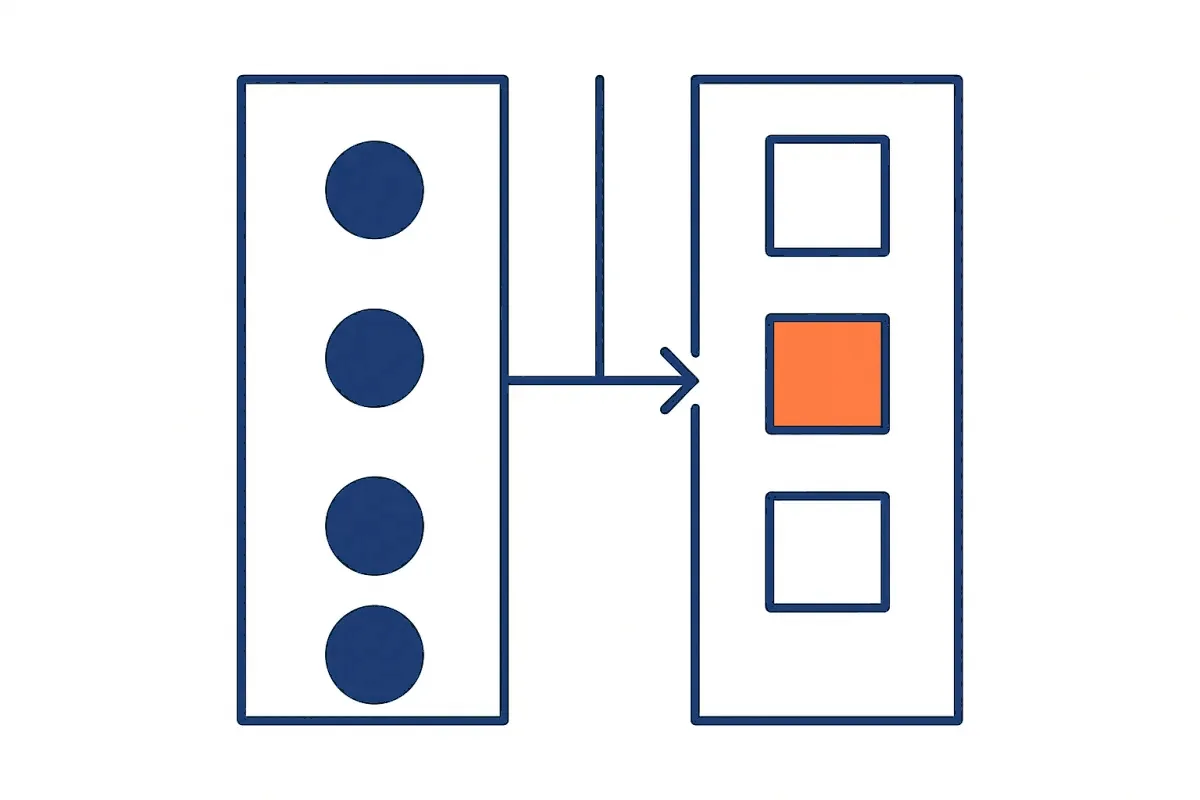
Not everything should transfer, and trying to transfer all of it produces the lifeless company voice that made the twenty-person firm's enquiries fall. The sorting rule is simple: opinions stay personal, mechanisms move to the firm.
What stays with the founder:
- The point of view. "A sales problem is usually a marketing problem" is my sentence, and it reads as mine. Opinions are held by people. A firm cannot be opinionated, but its founder can be, in public, on the firm's behalf.
- The stories. First-hand experience is the strongest proof in B2B services, and it is personal by nature. The research lab, the firm I sold, the client who argued with me. These do not belong to a logo.
- The relationships at the top. The managing director who calls you directly will keep calling you. That is fine, as long as the work that follows the call is done by the firm.
What moves to the firm:
- The method. If the way you diagnose, plan, and deliver has a name and a written form, it belongs to the firm and can be taught. If it lives only in your head, it is you.
- The proof. Case studies, results, and testimonials should be about what the firm did, in the firm's voice, on the firm's site. A testimonial that says "Anoop was brilliant" is worth less to the business than one that says "the firm's process worked".
- The message. The message hierarchy the founder can say without a script is the one the firm should be able to say without the founder.
- The delivery. Clients should experience the firm's people doing the firm's method. The founder's role in delivery shrinks as the method is written down, which is the same work as scaling beyond the founder.
The mistake I see most often is the reverse sort: the founder keeps the method secret, because it feels like his edge, and hands the firm his opinions, which come out as bland corporate messaging. The result is a firm nobody can describe, run by a man everybody can.
Building the Transfer: Named Methods, Team Voices, Firm-Owned Proof
Transfer does not happen because you decide it should. It happens because you build three things that let it.
Name the method. The moment a way of working has a name, it stops being the founder's instinct and becomes the firm's property. I call mine CLEAR, and the name does a specific job: it lets a client hire the method rather than the man, and it lets a consultant on my side deliver the method without pretending to be me. The name should be plain and descriptive rather than clever, and it should be written down in enough detail that a competent new hire can run the first step of it unsupervised. That document is the firm's most valuable brand asset, and most firms never write it.
Add voices. A firm with one public voice is a founder brand whatever the logo says. The transfer begins when a second person is visible: a senior consultant writing under her own name about the work, a partner speaking at the association event you used to speak at, a delivery lead quoted in a case study. This feels risky to founders, who worry the second voice will be weaker. It usually is, at first. It gets stronger the same way yours did, by doing it weekly, and a firm with three credible voices is worth far more than a firm with one excellent one. Give the second voice a lane: a topic that is hers, so she is not a paler copy of you.
Own the proof. Move the case studies onto the firm's site, in the firm's name. Write them so the method is the hero and the founder is one of the people in the room. When a client offers a testimonial, ask for one about the outcome and the process rather than about you personally, and put it on the firm's page, not your profile. Over two or three years the firm's site accumulates a body of proof the founder's profile merely links to. That inversion, the profile pointing at the firm rather than the firm pointing at the profile, is the transfer made visible.
I saw the reverse of this recently in a growth consultant who became a family-business succession specialist. His own history was the credential, so the founder brand was the right choice, and it carried him into a two-year engagement. But the method he built around that history is now written down, and that is what will let the practice outlive the story that started it.
The Blended Model Most B2B Services Firms Should Run

Put the pieces together and the answer to "founder brand or company brand" is: both, in a fixed arrangement, with the ratio shifting over time.
The founder stays in front. He is the voice, the opinion, and the reason the first conversation happens. His name is on the articles and the talks, because that is what buyers respond to, and no amount of company-page discipline changes that.
The firm stands behind. It owns the named method, the written process, the case studies, the testimonials, and the delivery. When the buyer moves from the founder's article to the firm's site, he finds a business with a way of working and people who run it, not a page about one man.
The ratio moves on a schedule. In years one to three, the founder is perhaps ninety per cent of the public brand and that is correct. By year five, a second voice is visible and the method has a name. By year eight or ten, the firm's proof carries most of the weight and the founder's name is the introduction, not the entire case. Write the schedule down. Founders who leave the transfer to "when things settle" find that things never settle, because they are the thing that has not settled.
The examples are all around you, once you look. A law firm in your city is named after two founders, one of whom retired a decade ago, and the name still opens doors because the firm's work kept earning it. That is a completed transfer. Compare the agency where every pitch is fronted by the founder, every award is his, and the staff turn over yearly. Fifteen years in, it is still a founder brand, and it is still worth what he is worth on a given Tuesday. Both started the same way. One of them built the transfer.
Is the Brand the Business, or Is It You?
Founder brand versus company brand is not a branding question, in the end. It is a question about what the firm will be worth, and to whom, when the founder is not in the room. The founder's name is the right asset to build first and the wrong asset to build only. The work in between, naming the method, adding voices, owning the proof, is the same work as building a firm that can get clients without depending on referrals: it moves what is personal and unrepeatable into something the business owns and can run.
Is the brand the business, or is it you? Get in touch. Tell me where your last ten enquiries came from and who they asked for, and I will tell you honestly how much of the brand the firm actually owns. If it needs a closer look, the usual first step is the Pipeline Reality Check, a one-week diagnosis of where new business really comes from.

About the Author
Anoop Kurup
I'm a marketing consultant for B2B service firms in India. I fix the positioning, visibility, and lead generation behind weak sales. Before this: a research lab at GE, then patents and competitive strategy, then an intellectual-property firm I built and exited. I work with founders one engagement at a time from Bangalore.
More about meCLEAR · Retain
Is the brand the business, or is it you?
Tell me what you're seeing in your pipeline. I'll tell you honestly if I can help, and where I'd start.
Get in touch