
Lead Generation for Marketing Agencies in India
Agencies generate leads for clients and wait on referrals for their own. How an agency builds a pipeline it controls, without free pitches.
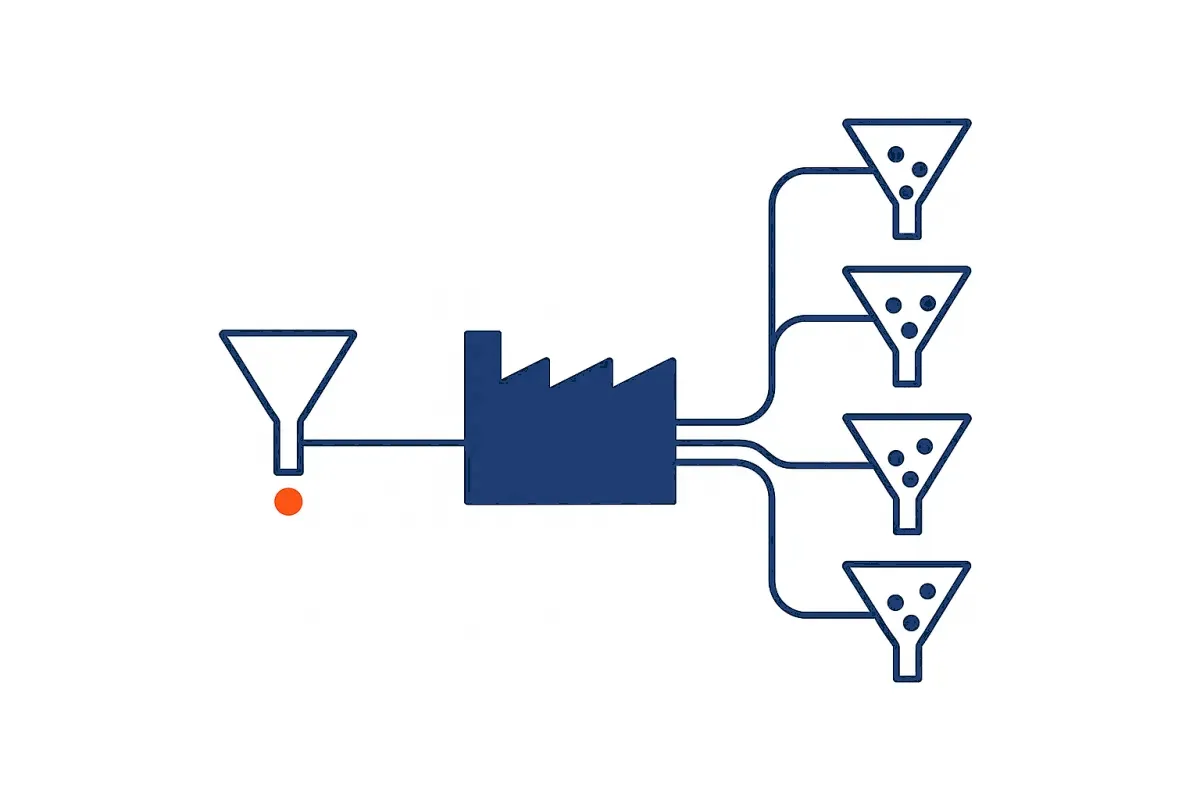
Ask a digital marketing agency where its last ten clients came from. I have asked that question of a great many agency founders, and the answer almost never includes the things the agency sells. Not search ads. Not SEO. Not a LinkedIn campaign. It is a friend of a friend, a former colleague who moved to a new company, a client who liked the work and mentioned it to someone at a wedding.
There is nothing wrong with any of those. Referred clients are often an agency's best clients. The trouble is what the answer reveals: a business that generates leads for other people every day has no reliable way to generate them for itself. When the referrals slow down, the agency does not switch on its own lead generation. It waits, and it worries.
I know this from the inside. I built and ran digital marketing businesses of my own before I started consulting, and I have since worked with advertising agencies, branding studios, video production houses and ad-creative shops on exactly this problem. This page is my guide to lead generation for marketing agencies: where agency clients actually come from, why the usual fixes fail, and the agency marketing strategy I use instead. If you want the narrower question of whether to bring in an outside advisor, that is covered in marketing consultant for agencies.
Why Lead Generation for Marketing Agencies Is Harder Than It Looks
An agency's sales problems look familiar. Pipeline swings between too much work and none. A few large accounts pay most of the bills. Pitches are lost to a cheaper shop with a similar portfolio. Prospects ask for a proposal, then go quiet.
The usual response is to pitch harder, polish the credentials deck, or hire someone to do business development. None of that touches the cause, because the cause sits earlier, in what a stranger can see of the agency before the first meeting.
Look at it from the buyer's side. A marketing head choosing an agency visits five websites. All five say strategy, creative, digital, social, performance. All five show a grid of attractive work for brands the buyer has heard of. All five promise results. The buyer has no way to tell which agency understands their situation, so they fall back on the only things left to compare: whoever someone they trust recommended, and the fee.
That is why referral dependence and price pressure turn up together in agencies. They are one problem seen from two sides. The agency has capabilities, which every competitor also has. What it lacks is a reason to be chosen by someone who has never heard of it.
There is also a structural reason agencies neglect this: the client always comes first. Marketing the agency is internal work, and internal work loses every argument with a client deadline. I go into that pattern, and why it produces the feast-and-famine cycle, in the marketing consultant for agencies article.
Where Agency Clients Actually Come From
Before building anything, it helps to be honest about the channels. Here is how I see the main sources of agency work in India, and what each is really good for.
Referrals and repeat clients. The foundation for almost every agency, and the one you cannot turn on when you need it. Keep them, earn more of them, but do not plan on them. How to stop relying on referrals covers the shift in detail.
Pitches and RFPs. Large brands and public sector bodies buy through formal pitches. They can bring big accounts, but they are expensive to enter, often decided on relationships you cannot see, and they pull the agency towards the large-client dependence that makes it fragile. Choose which pitches you enter as carefully as you choose clients.
Search and content. Buyers who search "branding agency for healthcare" or "performance marketing for education companies" have a real need and are comparing options. This works well for agencies with a clear focus, and badly for generalists, because nobody searches for "full-service agency that does everything". SEO for consultants explains the approach, and it applies to agencies unchanged.
Outbound. Cold email and LinkedIn messages can work for agencies, provided the message is specific to one kind of buyer and one kind of problem. A generic "we help brands grow" note is ignored by people who get twenty of them a week. Cold outreach for consultants covers how to write the kind that gets replies.
Partners. Other agencies with complementary skills, consultants who advise on strategy but do not execute, technology vendors whose customers need implementation help. Partner work is underused, and for smaller agencies it is often the fastest channel after referrals.
Awards and events. Good for reputation within the industry. Rarely a direct source of clients, because the people judging awards are other agency people, not buyers.
Notice what the reliable channels have in common. Search, outbound and partners all depend on the agency being clear about who it is for. A generalist can do all three and get very little from any of them. That is why the strategy below starts with position, not channels.
The Proof Problem: Every Agency Says It Gets Results
Lead generation for digital marketing agencies has one extra difficulty. Every digital agency claims results. Every one of them has a case study with a graph that only ever rises. Buyers have seen so many of these that they no longer believe any of them.
The agencies that break through this show something harder to fake: how they think. Not "we grew traffic by a large percentage", which every competitor can also say, but what they noticed about a client's situation that others missed, what they chose not to do and why, and what changed in the client's business afterwards, not only in the dashboard.
A few examples of proof that carries weight:
- A performance agency writing up why a client's cost per lead was rising, what it found in the landing page and the sales follow-up rather than the ads, and what it changed.
- A branding studio explaining the three positioning routes it considered for a client, and why it recommended the least obvious one.
- A web development agency publishing the checklist it uses before quoting a rebuild, including the questions that usually reveal a rebuild is not needed at all.
- A video studio showing the brief that went in and the business question the film answered, not only the finished reel.
The portfolio grid shows craft. Buyers assume craft. What they cannot assume is judgement, and judgement is what they are really paying an agency for. Brand building for professional services goes deeper on building this kind of reputation, and agencies are a professional service like any other.
One caution, which matters in India more than elsewhere. Clients rarely want their numbers published, and some do not want their names used at all. You do not need either. A clearly described situation, a decision, and a result in plain words is often more persuasive than a percentage a buyer cannot verify anyway.
Why Free Audits and Spec Pitches Keep Agencies Stuck
The most common lead generation tactic among Indian agencies is the free audit. Free SEO audit, free social media audit, free website review. It feels generous and low-risk. In my experience it is one of the main reasons agencies stay stuck.
A free audit attracts people who want free advice. Some of them are genuine buyers; many are collecting three audits to hand to their in-house team or their cheapest vendor. The agency spends hours on each one, learns little about whether the prospect can buy, and trains the market to expect its thinking for nothing.
Spec pitches do the same damage at a larger scale. When a brand asks four agencies to produce creative without a proper brief, it is not judging which agency understands its business. It is judging four guesses. The agency that wins is often the one that guessed closest to what the client already had in mind, which tells you nothing about who would do the best work over a year.
The alternative is a small, paid, clearly scoped first step. A two-week brand diagnostic. A performance audit with a fixed fee and a written recommendation. A one-day workshop to settle the brief before any creative work begins. Asking a stranger to pay a modest amount for a defined piece of thinking does three useful things: it filters out people who were only shopping, it lets the buyer experience your judgement on their real problem, and it very often turns into the larger engagement. A branding agency I worked with built exactly this, a focused brand diagnostic that let prospects try the agency's thinking before committing to a full identity programme; the story is in the branding agency with no brand of its own. I explain how to design one in how to productise your service.
An Agency Marketing Strategy in Four Parts
The marketing agency growth strategy I use has four parts. They follow the CLEAR method I work with, but the parts matter more than the names, and they are the same four I describe in marketing for professional services firms, applied to agencies.
A position a stranger can remember. "Full service" is a menu, not a position. An agency can narrow in three ways: by sector (branding for healthcare firms), by problem (launching regional brands in a new city), or by buying moment (the rebrand after a funding round). You do not have to turn away other work. You are choosing what you are known for. An advertising agency I worked with could not describe what it sold in two sentences, so we built one clearly defined campaign a stranger could understand and buy; it is written up in one campaign a stranger could buy. Positioning for consulting firms applies to agencies almost word for word.
Proof of judgement in public. Everything in the proof section above. Written in the founder's name as much as the agency's, because buyers trust people before logos. The balance between the two is in founder brand vs company brand.
Presence where the need appears. Agency buyers look for help at particular moments: a new marketing head joins, a product launches, a funding round closes, the current agency disappoints. Be visible where those people look at those moments, through search for your specific focus, through LinkedIn, and through the partners who see those moments first.
A first step a stranger can take. The paid diagnostic above. Without it, every new relationship has to start with a large commitment, and hesitant buyers simply drift away.
Most agencies I meet have none of these four in a clear form, and a few have a vague version of the first. Putting all four in place changes the kind of enquiry that arrives. People turn up already knowing what you do and who you do it for, and the conversation starts from their problem instead of your credentials.
How It Changes by Type of Agency
The four parts hold across the agency world. What changes is the buyer, what they fear, and where the proof has to come from.
Digital marketing agencies compete in the most crowded category of all, with the most claims of results. Narrowing matters more here than anywhere, and the proof has to be about business outcomes, not channel metrics.
Performance marketing agencies sell numbers, which is both their strength and their trap: the buyer can switch to whoever quotes the lowest cost per lead. The way out is to own more of the outcome. An ad-creative agency I worked with learned this when it tried to move from a few large clients to many smaller ones, and found smaller clients were buying the whole process, not the ads; that story is in from a few big clients to many small ones.
Branding and design agencies are judged on aesthetics and then pushed on price, because good-looking portfolios all look alike to a buyer. Specialising by sector and leading with what a brand is bought for, rather than the deliverables, is usually the turning point. Two branding engagements of mine show different routes: specialising by sector and breaking the feast-and-famine cycle.
Web design and development agencies get compared line by line on quotes. The ones that escape this sell the business result of the website, and they qualify hard before quoting, because a large share of rebuild enquiries do not need a rebuild.
Advertising agencies often sell a list of media and capabilities. Packaging one clear campaign offer around one kind of buyer changes how a stranger reads them, as in the advertising agency case.
Video and content studios get filed as vendors and asked for a per-video rate. Tying the work to the buyer's real business question moves them out of that box; the full story is in out of the editing-rate trap.
I will write a dedicated guide for each of these agency types in time, and link them here as they go live.
A New-Business Rhythm That Survives Delivery
Strategy tells the agency what to say. The rhythm is what makes it happen every week, including the weeks when three clients are unhappy at once.
The simplest idea that works: treat the agency as a client. Give it a brief, an account owner who is not the founder, a fixed weekly slot, and a place in the same status review as every paying account. Agencies are very good at protecting client deliverables and very bad at protecting internal projects, so make the agency's own marketing a client deliverable.
Then keep the routine small enough to survive a bad month:
- One point of view a week, published where your buyers already look, usually LinkedIn, in the founder's name.
- Five conversations a week with past clients, dormant contacts, partners and people who once asked for a proposal and went quiet. Not pitches. A useful note.
- One case study a quarter from work you have already delivered.
- Fifteen minutes each Monday reviewing every open conversation: what happens next, and who does it.
That is a few hours a week. It looks too small to matter. It matters because it keeps running when a large pitch or a difficult client would otherwise stop everything. The wider system around it is in the guide to getting clients beyond referrals, and B2B brand awareness without an ad budget covers how far a small agency can go before spending on its own ads.
What Working With Me Looks Like
Since it is the obvious question, here is how I work with agencies.
I start with a diagnosis, not a plan. The Pipeline Reality Check is a one-week look at where your new business really comes from: the last ten or twenty clients, who sent them, the pitches won and lost, and the enquiries that went nowhere. It tells us whether the constraint is marketing at all.
Sometimes it is not. If the agency is losing clients it already has, or is built to serve a kind of client it is no longer winning, better marketing will not fix that, and I will say so.
When it is marketing, the work follows the four parts above, then a weekly rhythm your team runs without me. Each engagement is scoped after a conversation, because a six-person studio and a sixty-person agency need different things. If you are still deciding whether an outside advisor is worth it at all, the buyer's guide to hiring a B2B marketing consultant in India covers the questions to ask, including the ones to ask me.
Selling Leads, Short on Your Own?
Agencies are the firms best equipped to generate their own leads and the least likely to do it. The skills are already in the building. What is usually missing is a position narrow enough to be remembered, proof that shows judgement rather than craft, a paid first step a stranger can take, and a weekly routine that does not stop when client work gets heavy.
Selling leads, short on your own? Get in touch. Tell me where your last ten clients came from, and I will tell you honestly whether the fix is marketing, and what I would look at first. If it needs a closer look, the usual first step is the Pipeline Reality Check, a one-week diagnosis of where your new business really comes from.
Common questions
How do marketing agencies get clients?
Most agencies in India get the majority of their clients from referrals, repeat work and the founder’s network. The agencies that grow steadily add three things on top: a clear position a stranger can remember, public proof of how they think and what their work changed, and a small paid first engagement that lets a new buyer try them. Pitches, cold outreach and search all work better once those three are in place.
What is the best lead generation strategy for a digital marketing agency?
Narrow first, then publish. A digital agency that serves one sector or solves one problem can write specific content, run specific outreach and show specific case studies, which a generalist cannot. Pair that with steady conversations with past clients and a paid audit as the entry point. Paid ads for the agency itself rarely work early, because every competitor is bidding on the same words.
Should an agency do free audits or spec work to win clients?
Rarely. Free audits attract people shopping for free advice, and spec work trains buyers to judge you on a guess made without a brief. A short, paid, clearly scoped diagnostic does the same job better: it filters for serious buyers, shows your thinking on their real problem, and often turns into the larger engagement.
How can I market my agency with no budget?
Most of what works for an agency costs time, not money: a point of view published weekly in the founder’s name, five genuine conversations a week with past clients and warm contacts, and one case study a quarter from work already delivered. The constraint is usually not budget. It is that client work always comes first, so the routine needs an owner and a fixed slot.

About the Author
Anoop Kurup
I'm a marketing consultant for B2B service firms in India. I fix the positioning, visibility, and lead generation behind weak sales. Before this: a research lab at GE, then patents and competitive strategy, then an intellectual-property firm I built and exited. I work with founders one engagement at a time from Bangalore.
More about meCLEAR · Engage
Selling leads, short on your own?
Tell me what you're seeing in your pipeline. I'll tell you honestly if I can help, and where I'd start.
Get in touch